















Interactions Between the Inhabitants of Bali and Foreign Regions in Prehistoric Times
Long before entering written history, the Island of Bali had already become a crossroads of cultures arriving through waves of migration and maritime trade. Archaeological evidence reveals interactions between prehistoric Balinese communities and Austronesian migrants, Southeast Asian traders, as well as contacts with India and China, placing Bali within an early international cultural network. These dynamic exchanges laid the foundation for the social, economic, and cultural development that would later shape Bali’s rich and enduring civilization.

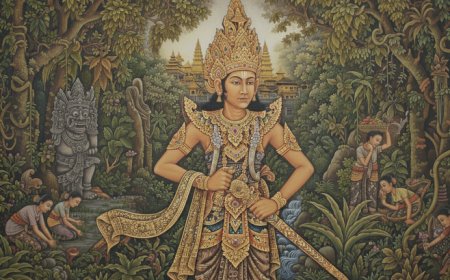
The origins of the inhabitants of Bali are rooted in the arrival of the Austronesian peoples, who are believed to have entered the Indonesian archipelago through two major waves of migration. The first wave, consisting of the Proto-Malayo–Polynesian groups, arrived around 3000–1500 BCE. They moved from Taiwan to the Philippines and further across maritime routes into western Indonesia, including Kalimantan, Sulawesi, Sumatra, and eventually the Island of Bali. From this first wave developed the Malayo-Polynesian languages, including modern Balinese, which still retains many features of its Proto-Malayo–Polynesian heritage. During this period, communities began practicing simple agricultural techniques, producing pottery, and advancing maritime navigation skills that enabled them to interact with other coastal populations.

AI Illustration of Balinese Communities Beginning to Apply Agrarian Culture (Source: Personal Collection)
The second wave of Austronesian migration, known as the Deutero-Malay groups, entered the archipelago around 500–300 BCE. They brought more advanced metalworking traditions, particularly bronze and iron technology associated with the Dongson culture that flourished in Vietnam between 600–300 BCE. In Bali, evidence of this culture has been found through fragments of bronze drum molds (nekara) discovered in the villages of Manuaba and Sembiran, indicating that the technological and symbolic traditions of Mainland Southeast Asia had reached Bali long before the emergence of early kingdoms. The spread of Sa-Huynh pottery from Vietnam (c. 500 BCE – 200 CE) and Kalanay pottery from the Philippines (c. 500 BCE – 100 CE) further supports the idea that Bali was deeply connected to a broader network of Austronesian and Southeast Asian cultural exchange during prehistory.

Pejeng Bronze Drum (Nekara Pejeng) (Source: Urs Ramseyer)
Around the same period, approximately 500 BCE to the early centuries CE, Bali also established early contact with India. Traders and sailors from South Asia brought various goods that have been discovered as archaeological remains, including Indian pottery with distinctive motifs, brightly colored glass beads, and carnelian beads that were widely traded in South Asia during this era. These findings reveal that maritime trade routes between India and Southeast Asia had already formed long before Hindu-Buddhist influence began to flourish in the Indonesian archipelago.
In addition to direct interactions, descriptions of the Indonesian archipelago appear in Chinese literature. The Chiu T’ang Shu (Old Book of Tang), compiled around 940–945 CE, mentions the existence of a region called Po-li. Although this record dates to a period later than prehistory, the information it contains is believed to reflect older oral traditions and knowledge about the maritime world of Southeast Asia. Po-li is described as a kingdom located on an island southeast of Lin-yi, inhabited by dark-skinned people and ruled by a king bearing the Kshatriya title. P. Pelliot once proposed that Po-li referred to Bali, though many other scholars argue that Po-li was more likely situated in Kalimantan. Nevertheless, this textual reference demonstrates how regions of Indonesia, including Bali, had long been known to foreign writers and integrated into international maritime routes.
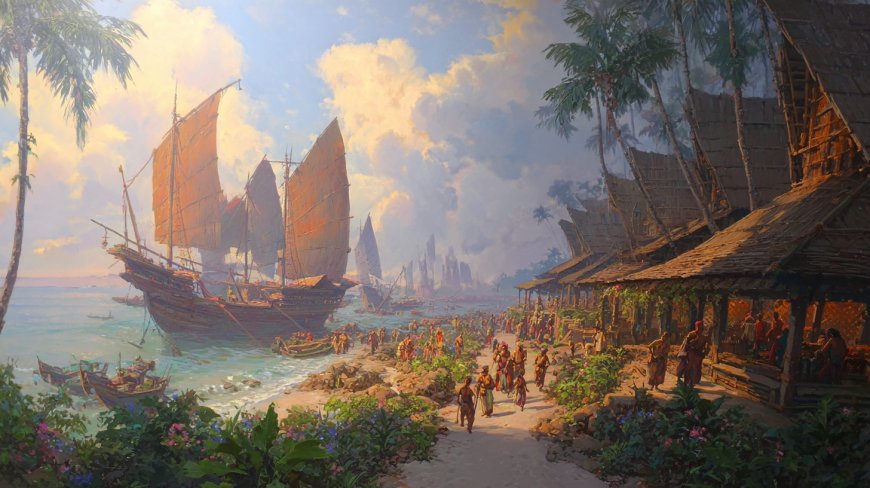
Towards the end of the prehistoric era, around 200 BCE to 200 CE, new trade networks began forming across Southeast Asia, connecting Indonesia with traders from India, China, and other regions. Bali became one of the key stopover points due to its supply of valuable commodities such as damar resin, rattan, tortoiseshell, obsidian, and locally produced beads used in ritual practices. These exchanges brought Bali increasingly closer to the outside world not only economically, but also culturally laying the groundwork for its later spiritual, cultural, and political development.

AI Illustration of Bali as One of the International Trade Routes (Source: Personal Collection)
Considering these various waves of migration and intercultural interactions, it becomes clear that prehistoric Bali was far from isolated. Since 3000 BCE, the island’s inhabitants were part of large scale Austronesian migrations, received Dongson cultural influences around 500 BCE, engaged in trade with Indian merchants by 500 BCE, and later participated in broader Southeast Asian trade networks in the early centuries CE. These interconnected processes formed the strong cultural foundations that eventually shaped Bali into a significant cultural and commercial center in the Indonesian archipelago.