



























From Copper Plates in Balinese Script: The Bet Ngandang Inscription as a Guideline for the Life of the Karaman Indrapura People
The Bet Ngandang Inscription is a written legacy from the Old Balinese period that holds high historical value because it records in detail the legal system, social obligations, and the mechanisms governing relationships between the kingdom, officials, and village communities. This inscription is preserved in the area of Banjar Bet Ngandang, Desa Pakraman Intaran, Sanur Kauh, South Denpasar, and is still safeguarded by the local community today. Its existence demonstrates that the tradition of writing in Bali functioned not merely as a historical record, but also as an official legal document and a means of religious legitimation that possessed binding authority in the lives of the society of its time.


The Bet Ngandang Inscription is a written historical relic that illustrates how important royal decisions were formally recorded and intended to remain valid over a long period of time. This is evident from the medium used, namely copper, which was shaped into thin plates or lampegan. Copper was chosen because of its strength and durability, allowing the contents of the inscription to serve as a long-term legal reference. The inscription is estimated to date back to the 14th century CE and was issued by Paduka Sri Maharaja Sri Jayasakti, the ruler of Bali who reigned around the Śaka years 1055–1071. The inscription consists of two groups of plates, indicating that the original text was quite extensive and contained complex regulations. The first group comprises five plates, numbered II, VI, VII, XIII, and XIV, while the second group consists of a single plate numbered III. Most of these plates are inscribed on both sides, except for plate XIVb, which contains writing on only one side. This arrangement suggests that the inscription was not discovered in its complete form, as several other plates are believed to have been lost or have yet to be found.
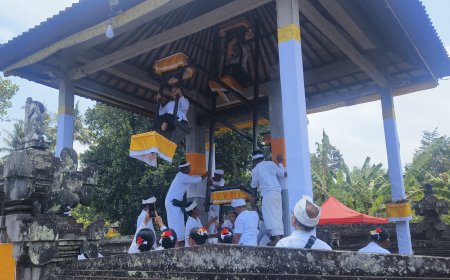
 The Process of Transmission of Bet Ngandang Inscription ( Source : Personal Collection )
Important Historical Heritage
In terms of physical dimensions, the plates in the first group measure approximately 37 cm in length, 8.7 cm in width, and about 0.20 cm in thickness. Their elongated and relatively thin form allows text to be inscribed on both sides. Each side generally contains five lines of writing, enabling a single plate to accommodate a fairly dense amount of information. This indicates that the inscription medium was designed to record administrative and legal provisions in a concise yet clear manner. Meanwhile, the plate in the second group is larger in size, measuring around 41.6 cm in length, 7.6 cm in width, and approximately 0.15 cm in thickness. These differences in size and thickness suggest that the two groups were likely produced in different temporal or situational contexts, although they still belong to the same writing tradition.
The Bet Ngandang Inscription was written using Old Balinese script or Kawi-Balinese script and employs the Old Javanese language. The use of this script and language confirms that the inscription functioned as an official royal document related to administrative, legal, and religious affairs. The neat writing pattern, consistent number of lines, and the use of both sides of the plates indicate the existence of established standards in inscription writing during the Old Balinese period, aimed at ensuring clarity of content and the legal authority of the decisions recorded.
 The Process of Describing of Bet Ngandang Inscription ( Source : Personal Collection )
Historical Written Content
The content of the inscription in the first group primarily concerns the exemption from certain obligations and certain taxes for the people of Karaman Indrapura. These exemptions were granted because the community had specific duties in carrying out the worship of Bhatara who resided at Bukit Tunggal, thus the inscription functioned as a means of regulating the relationship between religious obligations and the socio-economic rights of the people. In addition to tax exemptions, the inscription also contains provisions regarding the use of natural resources, such as permission to cut candlenut and sugar palm trees for practical purposes, including the construction of houses, meeting halls, and the management of rice fields, indicating the existence of official royal regulations over the environment and natural resources. The text of the inscription also mentions a number of royal officials along with the positions they held, such as Samgat Caksu Karanakranta held by Pangdudal, Mpungku Lokeswara by Dang Acaryya Abhipura, Mpungkwing Canggini by Dang Upadhyaya Widyottama, and Samgat Mangirendiren Wandani by Sangkawiryya, as well as other names such as Dang Acarya Agreswara, Dang Upadhyaya Layoken, Dang Upadhyaya Widiyatma, and Sang Kawiwya. The mention of these officials emphasizes that the decisions recorded in the Bet Ngandang Inscription were ratified through an official bureaucratic mechanism and therefore possess strong legal legitimacy.
 Group Two of Bet Ngandang Inscription, Plates IIIa - IIIb ( Source : Personal Collection )
Representation of the Second Group of Plates
Meanwhile, the second group of the inscription contains information regarding the grant of a fairly large tract of land to an official bearing the title Rsi Nara Rajapatih. The inscription also provides a detailed description of the boundaries of this land, reflecting its function as a written legal document that formally established land ownership and management rights. The careful recording of territorial boundaries highlights the importance of legal clarity in land control, while also demonstrating a well-developed administrative system.
Based on a comparison of script forms, plate dimensions, and textual content, it can be concluded that the first group of inscriptions is likely older than the second group. This indicates that the Bet Ngandang Inscription does not document a single event, but rather represents a continuity in the use of inscriptions as legal, administrative, and religious instruments over a certain period of time. Consequently, the Bet Ngandang Inscription serves as an important source for understanding the legal, religious, and social dynamics of Old Balinese society, and illustrates how the written tradition played a significant role in shaping social order in the past.