









































Eda Ngaden Awak Bisa: The Message of Pupuh Ginada on Humility
Pupuh Ginada is a legacy of Balinese oral literature rich in moral teachings, particularly about humility, politeness, and wisdom in behavior. Its famous verse, “Eda ngaden awak bisa, depang anake ngadanin,” reminds us not to be arrogant and to let others judge our abilities. This pupuh teaches that knowledge is endless, and therefore humans must continue learning while maintaining courteous speech and respectful manners. Its simple yet profound message remains relevant today, serving as a guide for life across generations in the midst of modernity.


In Balinese tradition, Pupuh Ginada is not merely a song, but an oral literary heritage filled with moral values. Its well-known verse, “Eda ngaden awak bisa, depang anake ngadanin,” teaches the importance of humility, politeness, and wisdom in conduct. This simple yet profound message has served as a life guide for generations of Balinese people. It emphasizes that a person’s greatness is not measured by self-proclamation, but by the courtesy felt and appreciated by others. Pupuh Ginada, therefore, is not just a song but a timeless guide to life that remains relevant in the modern era.

A majestic mountain and rice fields symbolizing humility (Image Source: AI Illustration)
When discussing Balinese literature and art, one cannot separate them from the existence of pupuh. This traditional form of literary expression is performed in the style of a song, carrying moral and ethical teachings passed down from generation to generation. Among the many pupuh, one of the most popular and frequently quoted in daily life is Pupuh Ginada.

A Balinese elder teaching students with respect and humility (Image Source: AI Illustration)
Pupuh Ginada has its own uniqueness because its verses are simple, easy to remember, yet full of life lessons. One of its most famous stanzas reads:
De ngaden awak bisa
Depang anake ngadanin
Geginane buka nyampat
Anak sai tumbuh luu
Ilang luu buka katah
Yadin ririh liu nu peplajahan
When translated, this stanza means: “Do not think of yourself as the most capable; let others be the ones to judge. What matters is not speaking much, but speaking politely and acting with respect.” Its message emphasizes that we should not assume ourselves to be knowledgeable; let others be the ones to assess us. It is like sweeping—trash will always reappear, and even when it seems gone, dust will remain. Likewise with knowledge: even if we feel we are already smart, there will always be new things to learn.
Just like the song Putri Cening Ayu, which soothes children’s hearts, Pupuh Ginada serves as a calming reminder for adults. In the era of social media, when many people tend to highlight their own achievements, this pupuh advises us not to be consumed by arrogance. In the professional world, it teaches the importance of humility and politeness in building harmonious relationships.

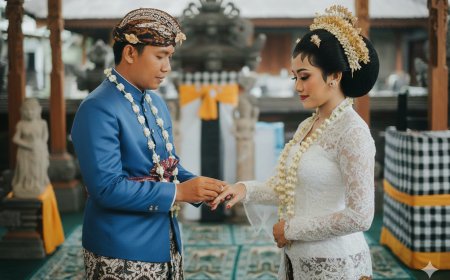
A man greeting an elder (Photo Source: AI Illustration)
Pupuh Ginada proves that the teachings of the Balinese ancestors are eternal. Its values are timeless, always relevant, and can serve as a guide for life. It reminds us that true intelligence is not only about knowledge or skills, but also about character and humility.
Such profound messages are present in Pupuh Ginada. With simple and straightforward language, this pupuh is able to touch the hearts of anyone who hears it. That is the uniqueness of Pupuh Ginada—it is not complicated, yet full of meaning that remains relevant throughout time. Through its verses, we are invited to learn humility, to watch our words, and to maintain polite behavior. How wise it is that the Balinese ancestors used the art of tembang (traditional song) as a medium to instill moral values.