







































Geguritan Niti Raja Sasana: An Eternal Critique of Negligent Leaders
Amidst rampant corruption and a crisis of confidence in leaders, an ancient manuscript from the Javanese-Balinese tradition, Geguritan Niti Raja Sasana, offers a timeless mirror. This article explores how the noble leadership teachings of the past—which uphold compassion, justice, and trust—are in fact the sharpest criticism of modern rulers who are entangled in greed and neglect of their people. More than mere historical nostalgia, this piece is a profound reflection on the nature of power, morality, and the enduring legacy left by every holder of trust.


Amidst rampant news stories about abuse of authority and officials who are seduced by luxury, it is often thought that the ethical crisis among leaders is a modern phenomenon. However, if we look back at history, the wisdom of the past seems to whisper that the struggle between trust and lust for power is a recurring story.
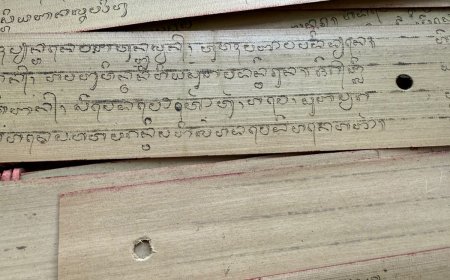
One such timeless record is preserved in the ancient manuscript Geguritan Niti Raja Sasana. This literary work is not merely a collection of outdated advice, but a mirror designed to reflect the true nature of leadership. In it, the noble standards of a true leader whose main duty is to bring prosperity to the people are clearly laid out. This manuscript also gives a stern warning, as if to say that power exercised without compassion will ultimately lead to fragility.

A Mirror of the Past in the Present, AI Illustration (Source: Private Collection)
Through its verses, Geguritan Niti Raja Sasana reminds us that greed and negligence are not new issues. Its teachings, which have transcended time, are now relevant again, offering a benchmark for assessing those in power. Isn't the image of a leader who cares more about personal wealth than the fate of the people a portrait that is still so familiar today?
The Noble Standards of a Leader: A Reflection of Niti Raja Sasana
Before offering criticism, Geguritan Niti Raja Sasana first presents a mirror—a complete picture of an ideal leader. The standards set are not about wealth or military strength, but about character and morality. This text emphasizes that the highest duty of a ruler is ngraksa gumi (to protect and bring prosperity to the world/people). This responsibility demands compassion, especially towards those who are suffering and in need.
A true leader, according to this text, is someone whose heart is easily moved to give, not someone whose hands are eager to accumulate wealth for themselves. This leadership ethic is also reinforced by the teachings of Catur Pariksa, four foundations of behavior that must be upheld. One of its objectives is for leaders to “sampun salang surup, katungkul nurut wisaya”—to avoid becoming confused or losing direction by indulging their desires. It is these desires that are the main gateway to negligence and destruction.
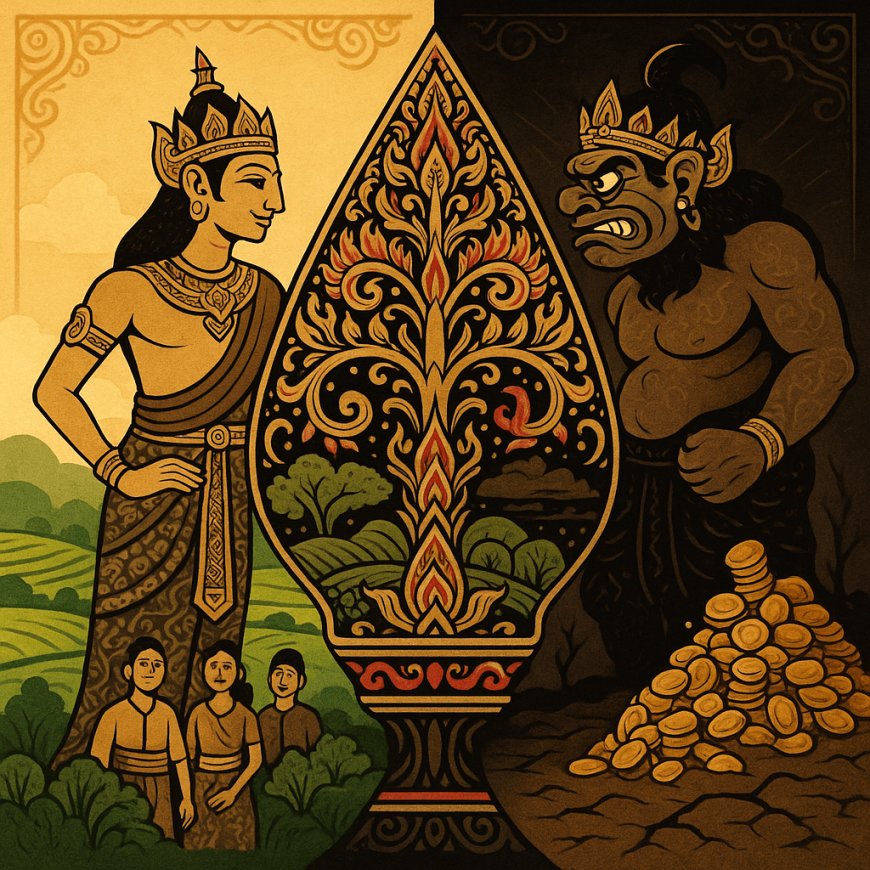
Symbolism of Two Paths of Leadership, AI Illustration (Source: Personal Collection)
The Eternal Disease of Power: Greed and Negligence
After setting lofty standards, Niti Raja Sasana sharply exposes the eternal disease that often afflicts those in power: greed. This text seems to serve as a timeless warning that when a leader begins to equate his position with an opportunity to amass wealth, he has embarked on a path of negligence. The description of a king who is stingy, arbitrary, and focused only on personal luxury is the main satire in this text.
This criticism feels particularly relevant when juxtaposed with today's reality. The phenomenon of public officials embroiled in trillions of rupiah in corruption cases, or the luxurious lifestyles flaunted amid the economic hardship of the people, are modern reflections of the leaders warned against in this text. Geguritan Niti Raja Sasana seems to ask: what is the point of power if it is only used as a tool to satisfy personal desires, while the mandate to bring prosperity to the people is ignored? This negligence, according to the manuscript, is the greatest form of betrayal by a leader.
Ultimately, the Geguritan Niti Raja Sasana is not merely a literary relic from the past. It is an eternal voice, a whisper of wisdom that continues to echo across the ages to remind each generation of the true nature of power. This text clearly shows that the standard of true leadership is not measured by how much wealth is accumulated, but by how much prosperity is brought to the people.
The sharp criticism of greed and negligence written in it is proof that the greatest challenge for a leader remains the same, both then and now: the battle against personal desires. This ancient teaching serves as a collective mirror, inviting everyone to reflect on the state of leadership around them.
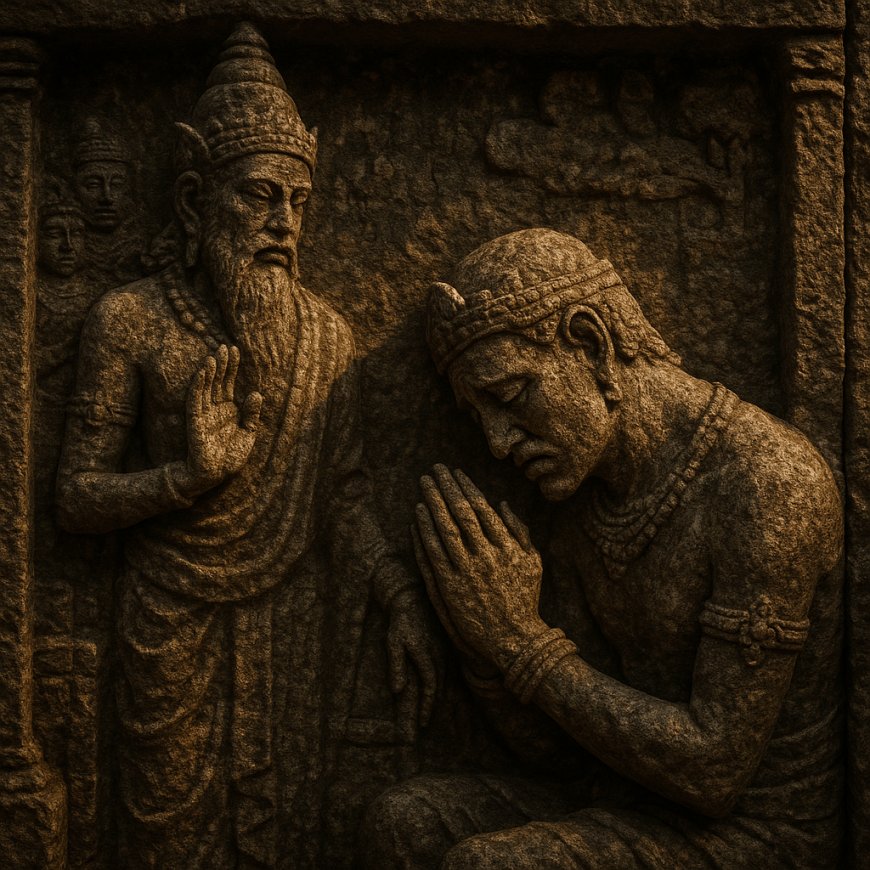
A Leader Begging for Forgiveness, AI Illustration (Source: Personal Collection)
Thus, the legacy of Niti Raja Sasana is not to be memorized, but to be reflected upon. It is a reminder that history will always record two types of leaders: those who are remembered for their compassion and wisdom, and those who are forgotten for neglecting their mandate. That choice, then and now, is always in the hands of those in power.