








Meayunan at Gunung Sari Temple: A Tradition for Purified Menopausal Women
At Gunung Sari Temple, Gianyar, a rare tradition called Meayunan is preserved. This ritual is the culmination of the temple’s odalan, in which women who no longer menstruate and have undergone a purification ceremony climb onto a sacred swing. Spun three times forward and three times backward by the Prajuru, this tradition is said to be found in only a handful of temples in Bali. What makes this swing so special that it is eagerly awaited every year?

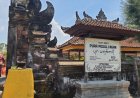
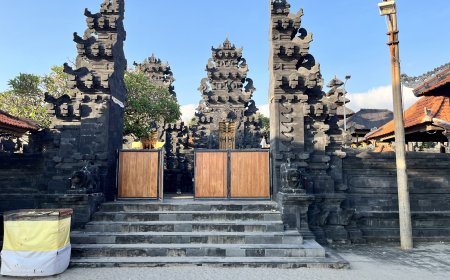
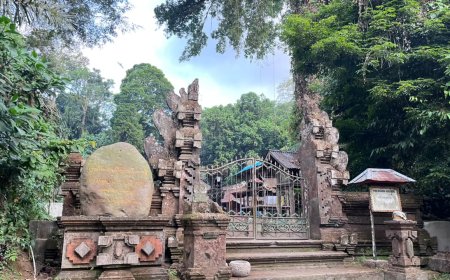
Speaking of temples in Bedulu Village, Gianyar, many people may immediately think of the grandeur of Samuan Tiga Temple. However, only a few hundred meters away lies another equally captivating Kahyangan Tiga Temple. Its name is Gunung Sari Temple. Located in Banjar Wanayu, Bedulu Village, Blahbatuh District, the temple is worshipped and maintained by the communities of Banjar Wanayu and Banjar Mas, which are now united under a single customary community known as Banjar Adat Wanayu Mas. Although less famous than its neighbor, Gunung Sari Temple preserves a unique tradition rarely found elsewhere.
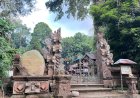
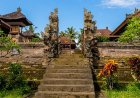
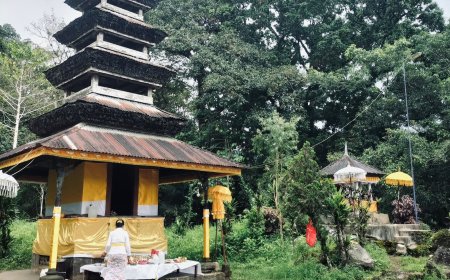
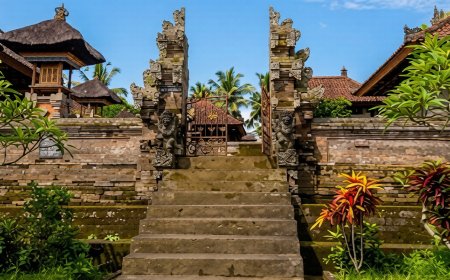
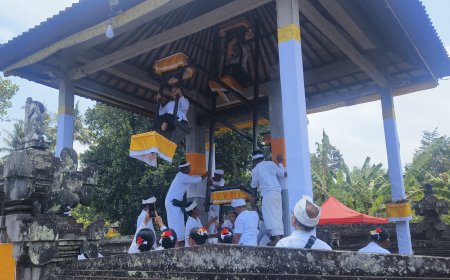
In the temple’s central courtyard (jaba tengah) stands a swing that becomes the center of attention whenever the odalan (annual Hindu religious ceremony commemorating the anniversary of a temple) is held. This swing tradition gives Gunung Sari Temple its own distinctive character amid the pressures of modernization. The tradition is known as Meayunan. According to the temple priest, I Gusti Ngurah Made Bagus (also known locally as Gusti Mangku Gunung Sari), the exact history of the temple’s establishment has not been recorded in writing. However, based on stories passed down through generations, the temple is believed to have existed since the 11th century.
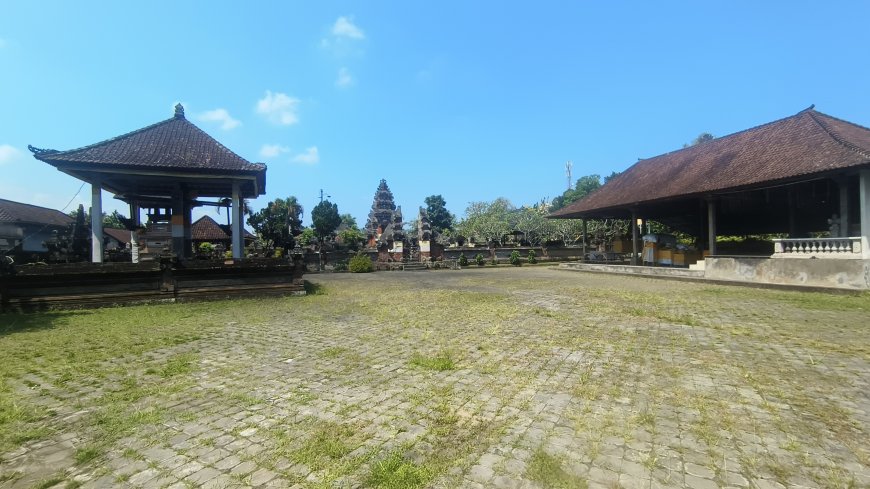
Central Courtyard of Gunung Sari Temple (Photo Source: Personal Collection)
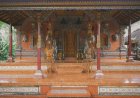
In the past, the temple complex was home to a magnificent Bale Agung, supported by 108 saka (supporting pillars). Unfortunately, the structure has since disappeared for unknown reasons and has never been rebuilt. Nevertheless, one remaining relic that has become an icon is the swing made of majegau wood, a high-quality type of wood often used for sacred structures in Bali. The swing is located in the temple’s jaba tengah (central courtyard). Although its supporting pillars were once renovated from wood into concrete, its sacred value has been preserved. The swing is also decorated with wastra (sacred cloth), as are sacred structures in general, emphasizing that it is not merely a toy but a ritual facility.
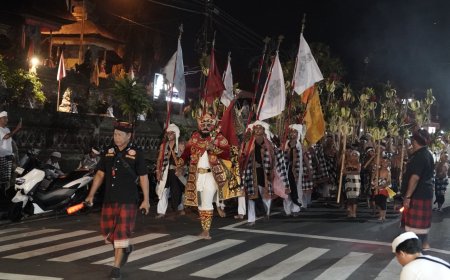
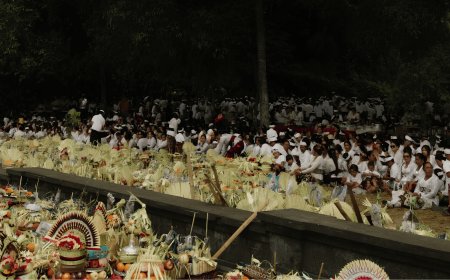
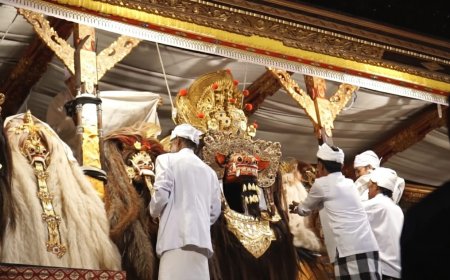
The odalan at Gunung Sari Temple lasts for four full days and is held once a year, precisely during the Purnama Sasih Kapat (the fourth month in the Balinese calendar). On the first day, a procession carrying Ida Bhatara (divine manifestations) from Samuan Tiga Bedulu Temple and Dalem Wanayu Temple lunga (arrives) at Gunung Sari Temple and melinggih (takes residence) there. On that day, a series of banten (ritual offerings) is presented, including Peras Ajuman, Sayut Pengambian, Japitan, Pesucian, Tebasan Perascita Durmanggala, and others. All of these offerings are puput or presented by Ida Pedanda (a sulinggih or high-ranking Hindu priest). After the ceremony, residents of Banjar Wanayu and Mas perform communal prayers.
The following two days are filled with the Penganyaran procession, which involves presenting Banten Penganyaran led by the temple priest. The people of Wanayu Mas also present Banten Penyacah Ajuman and Banten Gebogan, followed by communal prayers. At night, from the first through the third day, the temple becomes livelier. Various art performances are held, including entertainment dances, wayang kulit, drama gong, arja, and others. These performances provide an opportunity for residents to celebrate while preserving Balinese artistic traditions.
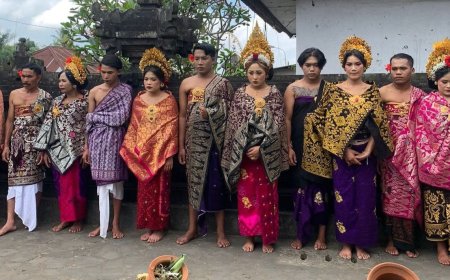
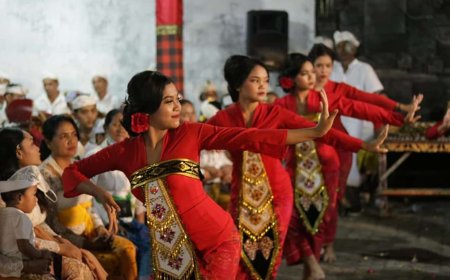
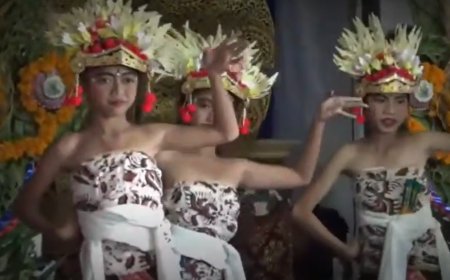
On the fourth day, the culmination of the entire odalan finally arrives. On this day, Ida Bhatara from Samuan Tiga Temple and Dalem Wanayu Temple will budal (return home). Before the budal procession begins, Meayunan becomes the most anticipated ritual. Before Meayunan, the Mapurwa Daksina ceremony is first held, followed by the Nampyog Dance, performed by a group of women. They are not ordinary dancers. They are Sutri or Permas, women who no longer menstruate and have undergone the Kalahyang purification ceremony. The purification ceremony for the Sutri of Wanayu Mas Traditional Village is usually held at Samuan Tiga Temple.
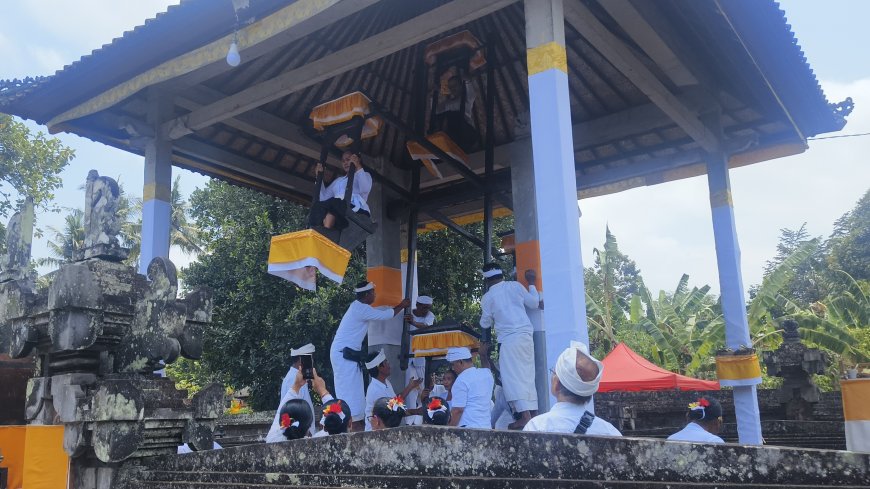
After the dance ends, it is time for Meayunan. The Sutri take turns riding a uniquely shaped swing resembling a small Ferris wheel. The swing has four seats and rotates 360 degrees vertically, moving its passengers upward and downward in a circular motion. Since there are only four seats, only four Sutri can ride at a time. However, all Sutri who are present will take turns until everyone has experienced this sacred experience.
The swing is then operated by the Prajuru or Parekan, all of whom are men. The Prajuru or Parekan are also sacred individuals who have undergone ritual ceremonies similar to those performed by the Sutri. The swing is spun three times forward and three times backward. Interestingly, girls who have not yet menstruated are also allowed to participate in Meayunan. They usually perform the Rejang Dewa Dance first before riding the swing. However, in practice, menopausal Sutri are the ones most frequently seen performing this ritual.
The Sutri who participate in Meayunan wear clothing that is white on the upper part and black on the lower part. Sometimes, they also carry various ritual items, including Penastan (holy water), Canang Oyodan, as well as 2 Tetabuh (implements used to pour a liquid), namely Tetabuh Tuak and Tetabuh Arak (2 types of alcoholic beverages commonly used during ceremonies at the temple). These elements add to the sacred atmosphere of the moment.
So, what is the actual purpose of the Meayunan tradition? According to local residents, no one knows the exact philosophical meaning behind it. However, at least two interpretations have developed within the community. First, they believe that Meayunan serves as a form of entertainment for Ida Bhatara before the deity departs and returns to its place of origin. Second, the tradition is also regarded as an expression of happiness for the Sutri themselves. After undergoing a long sacred procession and performing dances, they are given the opportunity to “play” on the swing, creating a joyful moment that they may rarely experience anymore. It should be emphasized that these two explanations are merely local interpretations and oral beliefs, rather than accounts recorded in written historical sources. Yet this is precisely what makes the tradition so rich in mystery and local wisdom.
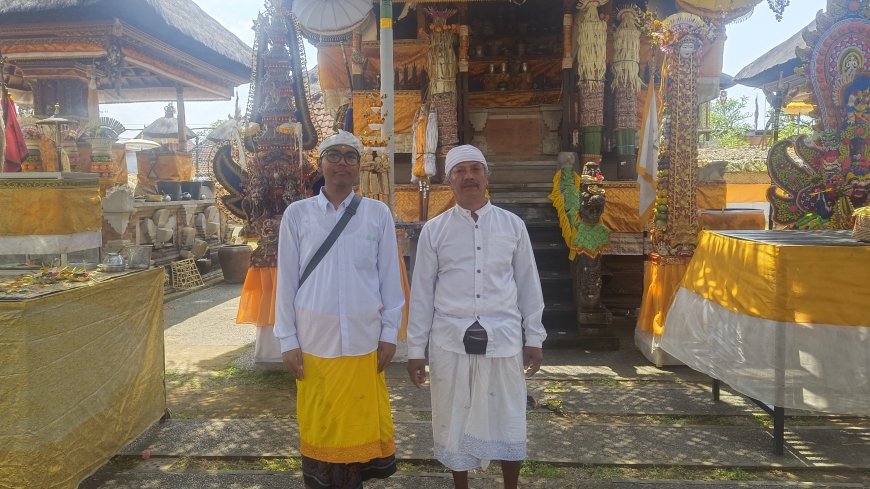
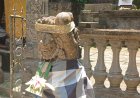
Documentation with the Interviewee, Gusti Mangku Gunung Sari (Photo Source: Personal Collection)
Meayunan at Gunung Sari Temple is not merely a tourist attraction or an ordinary game. The tradition reflects how Balinese culture embraces all layers of society, including women who have entered old age. Through this ritual, they are not only spiritually recognized through the Kalahyang ceremony, but are also given a space to celebrate and experience happiness in the presence of Ida Bhatara. Gunung Sari Temple may not be as famous as Samuan Tiga Temple next door. However, through its sacred swing and the Sutri who ride it, the temple has a story of its own that deserves to be remembered and passed down.