
























Wariga Patemon: Designing Harmonious Meetings for Compatibility in Relationships and the Business World
Wariga Patemon is a profound traditional Balinese system of calculation rooted in the philosophy of living in harmony with the universe. This concept is not used merely for prediction, but rather as a guideline for designing and understanding the dynamics of an encounter, whether it is the meeting of two hearts in marriage or the meeting of ideas within a business partnership.

Wariga is part of traditional Balinese calendrical knowledge and astronomy that serves as a guide for determining appropriate timing and actions. This knowledge is based on the belief that the universe moves in certain cycles, and that humans achieve the best outcomes when they live in harmony with those cycles. Wariga views humans as a microcosm connected to the macrocosm, where days, market days, and other calendrical calculations (wewaran) carry different energetic influences. Wariga Patemon, specifically, is the application of Wariga to analyze and design an encounter (Patemon). Here, Patemon is understood broadly, the meeting between two people, such as in matchmaking or marriage, the meeting between humans and a project, such as starting a business, or the meeting of various elements. Its calculations are based on combining and analyzing three main calendrical systems:
- Pancawara (Pasaran): Siklus lima hari (Umanis, Paing, Pon, Wage, Kliwon).
Each day within these cycles has its own numerical value known as Neptu or Urip (life value). Patemon analysis is carried out by summing the Neptu values of the elements being brought together, then processing the result through specific formulas to obtain an overview of the potential harmony, challenges, and prosperity of the encounter. The ultimate purpose is not to instill fear or impose limitations, but to cultivate awareness. By understanding potential dynamics from the outset, the parties involved can be better prepared to build communication, anticipate challenges, and strengthen the foundation of cooperation toward relationships that are lasting and productive.
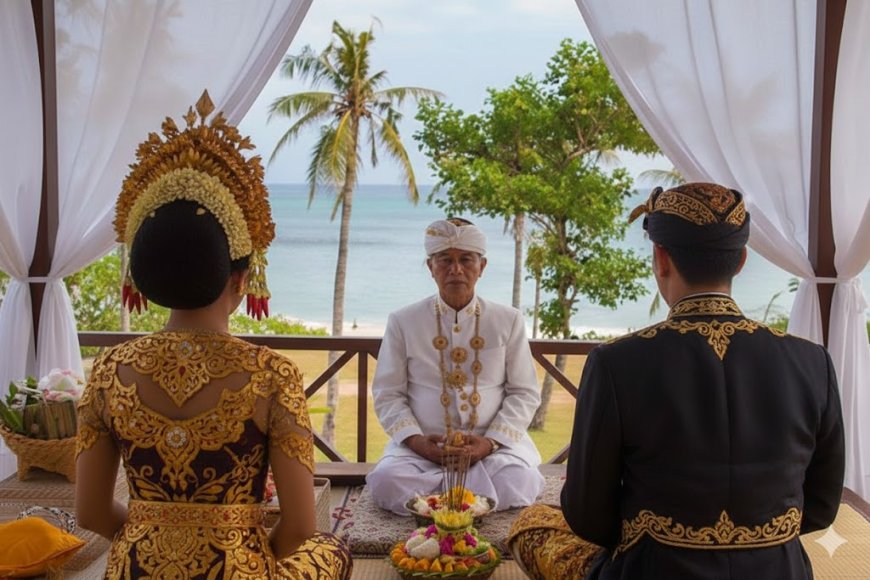
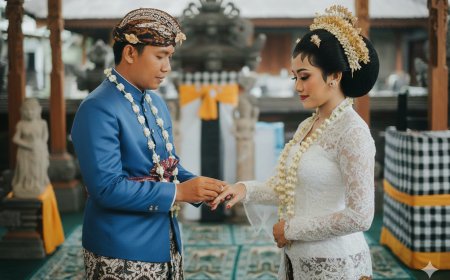
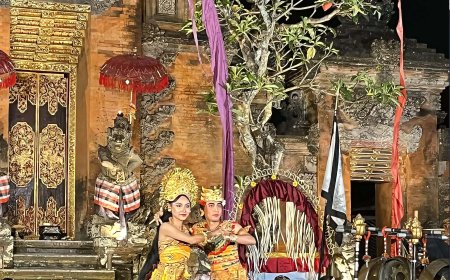
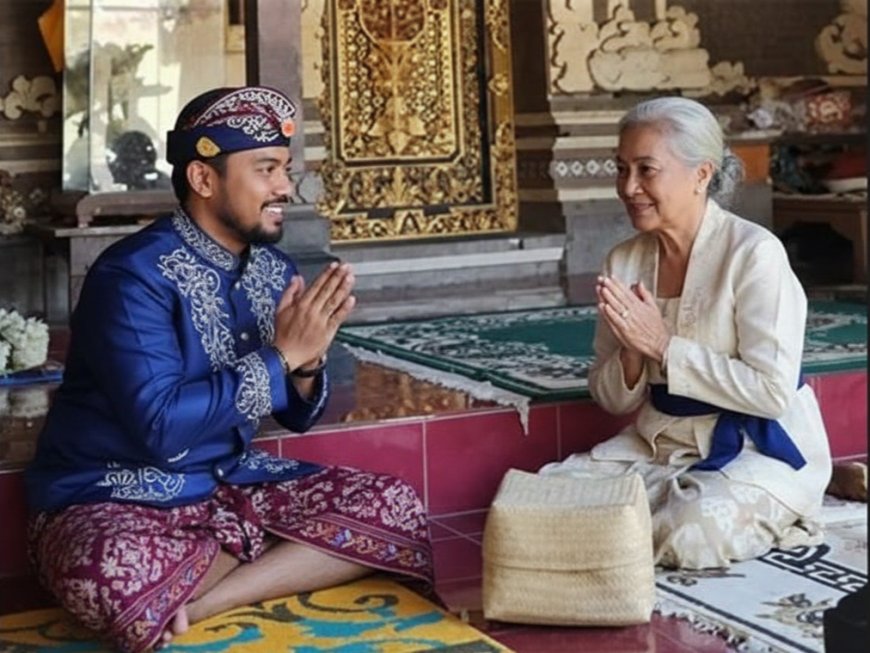
AI Illustration of Wariga Patemon in Marriage (Source: Personal Collection)
In the context of marriage, Wariga Patemon functions as an initial navigational map for prospective husband and wife. Its calculations are highly detailed and multi-layered, aiming to examine compatibility across various dimensions of married life.
The analysis of household conditions is carried out by summing the Panca Wara and Sapta Wara Neptu values of the husband and wife, then dividing the result by five. The remainder of this division is believed to represent the condition of married life in each five-year period. A remainder of one is called Sri, which signifies a life that is consistently prosperous and happy. A remainder of two is known as Gedong, meaning that there is no lack of clothing and food, or that life is materially sufficient. A remainder of three is referred to as Pete, indicating a household often marked by conflict, disputes, and hardship. A remainder of four is called Pati, signifying poverty and numerous life problems. Meanwhile, a remainder of zero is known as Lungguh or Sama, which reflects a household condition that tends to be stable or even improving.
From the previous example, the five-year calculation shows a cycle beginning with a Sri period, followed by Gedong in years six to ten, entering a Pati period in years eleven to fifteen, and so on. This type of analysis conveys that no relationship is static. It implies that there will always be phases of ease and difficulty that can be mapped cyclically.
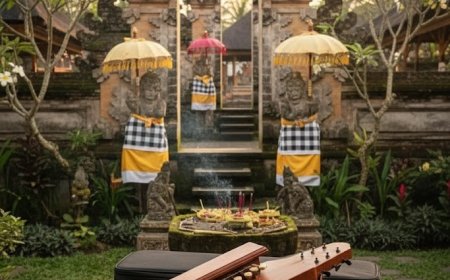
AI Illustration of Wariga Patemon in Business (Source: Personal Collection)
The core principle of Wariga Patemon regarding energy harmonization is highly relevant to modern business practice. If in marriage the meeting involves two individuals, in business what comes together are visions, resources, and the energies of partners, as well as the timing of the venture’s launch.
Beyond partner compatibility, a crucial aspect of Wariga Patemon in business is the selection of the right timing, or Dewasa Ayu, to initiate activities such as a grand opening, signing important contracts, or launching products. This selection holds a position comparable to choosing a wedding day. In Balinese tradition, the calculation of an auspicious day takes into account the wewaran, which includes sapta wara, panca wara, and sadwara on that day, the influence of stars or Nawa Sangga and cardinal directions, as well as the purpose of the business, since each day is believed to possess characteristics suited to different types of activities. Starting a business on a day considered ayu is believed to align the venture with natural frequencies, making it easier to attract good fortune or Sri Sedana, avoid early obstacles, and gain positive acceptance from the market.
Philosophically, the application of Wariga in business can be understood as a form of traditional strategic timing and risk management. This approach emphasizes the importance of pausing to plan carefully rather than acting hastily. Wariga also instills respect for non-material factors such as intuition, collective team energy, and broader market momentum. In this way, business is built with the awareness that success is not solely the result of hard work, but a combination of thorough preparation, consistent effort, and the ease that arises when the right timing is chosen. In the Balinese context, this practice remains widely applied, with many types of enterprises, from restaurants to art galleries, consulting Wariga experts before commencing operations as part of an effort to integrate local wisdom with modern business practices.
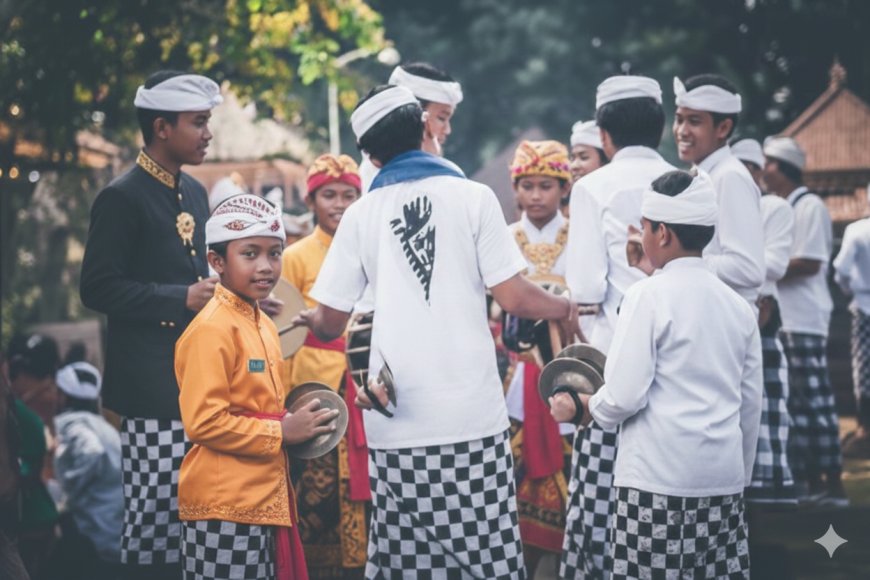
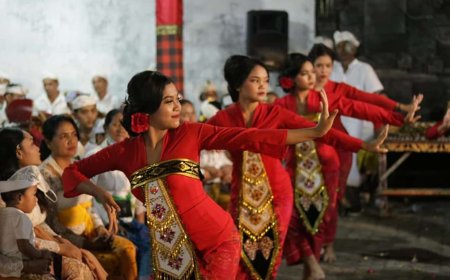
AI Illustration of Wariga Patemon Bringing Prosperity to All (Source: Personal Collection)
Wariga Patemon is not understood as an absolute, black-and-white form of prediction that rigidly determines outcomes. Its accuracy lies instead in its ability to map potential patterns and energies that emerge from an encounter, whether in personal relationships or in business contexts. It functions like a weather map that does not force rain or sunshine to occur, but provides early indications so that preparation can be made more wisely. Thus, the true value of Wariga Patemon does not rest on prediction alone, but on the awareness and readiness it cultivates before major decisions are taken.
On this basis, Wariga Patemon is more appropriately viewed as a planning tool rich in wisdom rather than a determinant of fate. It offers a perspective that the success of any encounter, whether in building a family or establishing a business, is supported by three main elements. The first is initial capital in the form of basic compatibility or mulet, analyzed through Patemon. The second is effort or karma, namely the commitment of all parties to continue communicating, cooperating, and adapting. The third is ease of timing, pursued by selecting the right starting moment through Dewasa Ayu. When these three elements are combined in balance, Wariga Patemon remains relevant as a guide for designing encounters that are aligned, harmonious, and oriented toward sustainability and long-term success.