
























Between Hammer, Prayer, and Modern Trends: The Other Side of Gold Craftsmanship Regeneration in Klungkung
In Tegak Village, Klungkung, gold is shaped not by casting machines but by hammer, fire, and years of patience. Yet contrary to what many assume, this craft is not passed down through bloodline, it grows from personal dedication, as shown by I Kadek Suana, one of the artisans still holding on amid the flood of factory-made jewelry and a younger generation drifting toward the digital world.

A fire burns atop the stand where a piece of 24-karat gold rests before it is melted down. In the hands of I Kadek Suana, that piece of metal will pass through dozens of stages before becoming a necklace worn at a temple, a traditional ceremony, or a family gathering. The process is hot, dirty, and takes a full two days to complete just one necklace. There is no casting machine, no digital template, only a hammer, physical effort, and years of accumulated skill.
For 18 years, Suana has practiced this craft in Tegak Village, Klungkung, one of Bali's pockets of traditional gold jewelry making. He did not start with gold, he began with silver. Only after three months of practice was he trusted to work with gold for the first time.
"In the early days, I was quite shocked by how difficult the process was, especially because most of it involves fire. So I had to get used to the heat first, after melting or burning the jewelry," Suana recalled.
Many assume that the skill of forging sacred gold jewelry in Bali can only be passed down through a specific lineage, as is the case with the Pande family, who practice blacksmithing. But according to Suana, that assumption does not fully hold true for gold artisans.
"For gold artisans, there's no inheritance system, because it comes down to personal interest or enjoyment. It's different from the Pande family, who practice blacksmithing, that really must be passed down. For gold artisans, it comes back to the individual, whether they enjoy the craft or not," he explained.
This fact shifts the common perception of the profession. What keeps gold craftsmanship alive in Tegak Village is not a binding customary obligation tied to bloodline, but individual interest and persistence, something Suana believes is actually more fragile in the face of modern temptations, since anyone can walk away at any time without feeling they have broken any rule.
Even so, a spiritual dimension still exists in the process, though not in the form of special mantras. Before starting work, Suana usually presents a pejati, a simple offering meant to help him stay focused and produce the best possible results.
"There's no special mantra, really, but there is an offering, like the pejati offering, when we're about to start work, so that we stay diligent and the results can be as good and smooth as possible," he said.
Determining dewasa ayu, or an auspicious day, is also still observed, not as a rigid requirement, but as a way of keeping the artisan's mood steady so he continues to enjoy the work day after day.

Gold Material being Melted and Shaped (Source : Personal Collection)
The process of making a gold necklace begins long before its shape becomes visible. Raw 24-karat gold is alloyed down to 22 karats, then melted. The material is then camplong, struck with a hammer, then dilindes, flattened and elongated using a special tool. This cycle of heating, hammering, and flattening is repeated over and over until the material stretches to roughly one meter, before finally going through pengaudan, where it is drawn out into thin wire.
Even the measurements are precise. For a 10-gram necklace, for example, with an extra 1 gram added as reserve, and a target length of 50 centimeters, an artisan has to calculate the wire so it comes out to around 3.5 meters. This calculation is known as klanji, a standard formula artisans rely on to keep the final result precise and well-proportioned once strung into a necklace.
Once the wire is ready, the process continues: it is cut, joined using patri (a soldering technique), reshaped through the elup and pelpel stages (flattening), flattened again with the lindes tool, polished through audin until smooth and shiny, then dikesod to remove excess material and match the intended weight. The final stages involve forming the ceklek (clasp), followed by penyepuhan, or plating, dipping the piece into a solution of saltpeter water mixed with salt and alum, before it is brushed and given a final polish, or disangling, until it shines and is ready to wear.
The tools used are equally distinctive: a hammer, pliers, pemaron (a forging stand), penglindesan (flattening tool), pengaudan (wire-drawing tool), a special forging stove, taktakan to hold the gold in place while it is being heated, and cutting shears. Among all these tools, the pemaron is one of the most carefully preserved, as it holds the status of a tool handed down through generations of forging practice.
Amid the flood of factory-made jewelry, far cheaper and faster to produce, Suana admits he does not feel especially threatened. According to him, there is a fundamental difference between handmade and factory-made gold that goes beyond price.
"Handmade gold is sturdier and stronger. Factory-made gold has a lower purity and is lighter, so it's more prone to breaking, not as strong as handmade gold," he explained. Factory-made gold is typically 18 to 21 karats, while gold made by Tegak Village artisans tends to retain a higher purity, a characteristic that makes it more durable for everyday wear.
That difference, Suana says, keeps handmade gold relevant to its own market among Balinese communities, even as mass-produced jewelry continues to flood store shelves.
"Artisan-made gold, whatever the price, is still in demand among Balinese people because the price stays consistent and the quality is good. Most mass-produced factory gold is only used for decoration," he said.
This is where the term taksu, a spirit or charisma believed to reside within a piece of work, finds its meaning in the context of Suana's craft. To him, taksu is born from the involvement of human feeling and thought in every strike of the hammer, something he believes a machine could never replicate.
"Artisans use human effort and human thought. When a person genuinely enjoys their work, and an artisan is really also a kind of artist, that's where the taksu comes from. The feeling an artisan puts into a piece can never be matched by a machine's output," he said.
Personal reputation, he says, is living proof of that value. Once an artisan builds a good name, customers come directly with the design references they want, rather than settling for mass-produced, uniform pieces.
As for digital marketing, Suana admits he hasn't touched it at all. This isn't due to lack of access, but because of a work pattern that has been in place for a long time: he receives orders directly from jewelry stores, produces the pieces to order, then hands over the finished gold. The stores then distribute the jewelry to end customers, meaning artisans like Suana have never needed to build their own online storefront.

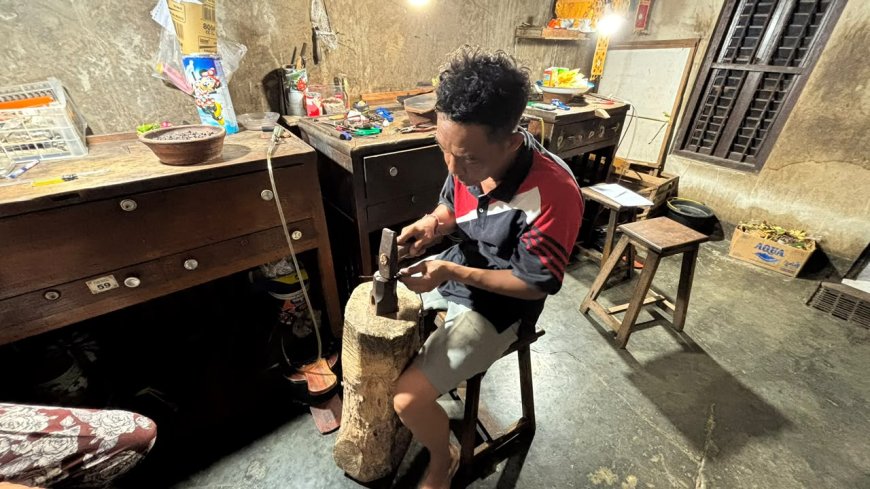
The Artisan's Workspace with Gold-Forging Tools (Source : Personal Collection)
The biggest question hanging over this craft is regeneration. Suana has watched firsthand as young people around him increasingly choose tourism or the digital sector over learning to forge gold.
"Young people today are more drawn to the digital world because working with gold like this is boring. If you work in tourism or digital work, you get to travel around, it's enjoyable. But being a gold artisan means heavy, dirty work, so few people want to continue it," he said.
Beyond prestige, another factor Suana points to is the length of the learning process. For him, personal interest determines whether that learning process feels light or becomes a burden.
"If you enjoy it, you can learn fast. But if you're not comfortable with it, it becomes like studying math for someone who doesn't like math, it just becomes exhausting, boring, and a burden," he said.
Still, he emphasizes that the skill can actually be mastered in a relatively short time by anyone serious about it, around six months to be genuinely ready to work with gold independently, given that the raw material is high in value and demands precision from the very start.
On the subject of taboos often associated with traditional crafts that intersect with sacred objects, Suana clarifies that in daily practice, the restrictions he takes most seriously are actually more practical than mystical: discipline and cleanliness at work.
"As for taboos, there's nothing spiritual about it, it's more about cleanliness. If you work carelessly or sloppily, don't wash your hands, that can cause material loss, and that loss is the artisan's own responsibility to cover. So after work, you have to wash your hands and always keep the workspace clean," he explained, a small detail that shows how carefulness with high-value material has become woven into a work ethic he has carried for nearly two decades.

Finished Gold Jewelry, Ready to Wear (Source : Personal Collection)
At the end of the interview, accompanied by his wife, Ni Made Budiani, Suana didn't ask for much. He wasn't seeking recognition or funding. What he wanted came down to one thing: someone willing to carry it forward.
"My hope is that there will be young people willing to continue this work, even though it's heavy and difficult, so that this legacy keeps being passed on. If no one continues it, it would be a shame, there would be no next generation of gold artisans in Bali, and goods from outside Bali would end up dominating instead. So that local wisdom stays alive," he said, closing the conversation.
Suana's story shows that what keeps Tegak Village's gold craftsmanship alive is not a binding customary rule, but something far more fragile and personal: one person's enjoyment and persistence toward the heat of fire, the sound of a hammer, and a long process that no technology can speed up. As long as someone is still willing to pursue it wholeheartedly, that taksu will keep living on, even as the number of artisans keeps shrinking year after year.