













Kuta Beach Skate Park: An Urban Arena and a Space of Expression in South Bali
Amid the constant movement and tourism-driven energy of Kuta, there is a public space that presents a different face of Bali, more urban, dynamic, and expressive. Kuta Beach Skate Park stands at the intersection between the open coastal landscape and the youth culture that thrives in public spaces. With the ocean as its backdrop, dramatic sunset skies, and the steady breeze of the shoreline, this skate park functions as more than a sports facility. It is a social space where interaction, creativity, and togetherness emerge naturally. Its presence illustrates how Bali’s local wisdom can coexist with modern urban culture, without losing the inclusive character of a public space.

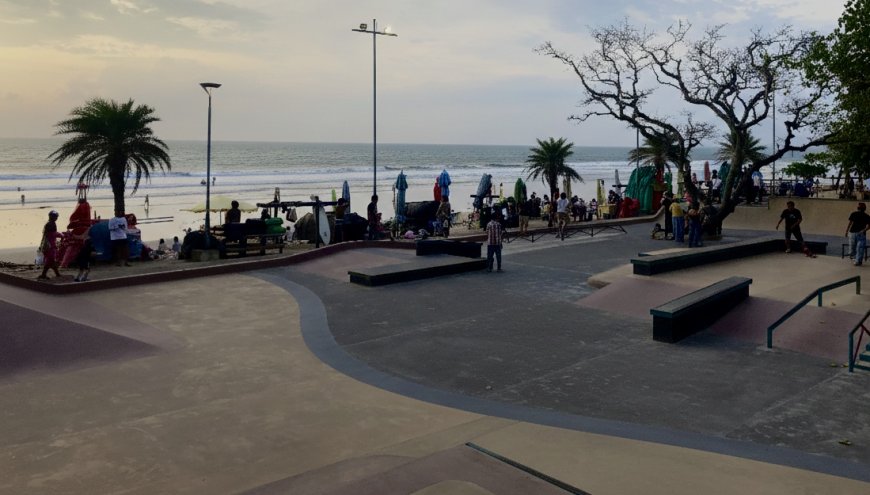
Kuta Beach Skate Park is one of the public spaces along the southern coast of Bali that blends an urban atmosphere with an open beach landscape. Viewed from a slightly elevated diagonal angle, the skate arena appears seamlessly integrated with its surroundings, concrete skate paths, landscaped park elements, and the distant coastline forming a continuous visual composition. The variety of visitor activities, from sitting casually to walking through the park area, creates a lively spatial dynamic that remains open and welcoming to anyone who comes.
More than merely a place for skating, Kuta Beach Skate Park functions as an active social space where locals and visitors interact without barriers. The presence of the sea as a dominant backdrop brings balance between urban character and coastal nature, giving the park not only functionality but also a strong sense of place. In the midst of Kuta’s crowded tourism zone, this skate park emerges as a space for expression and togetherness that grows organically within everyday life.
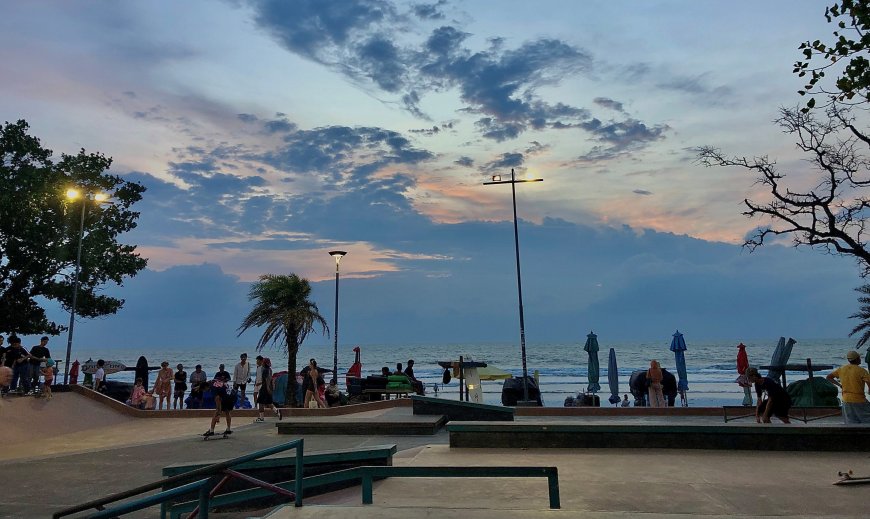
Side View of the Skateboard Arena (Source: Personal Collection)
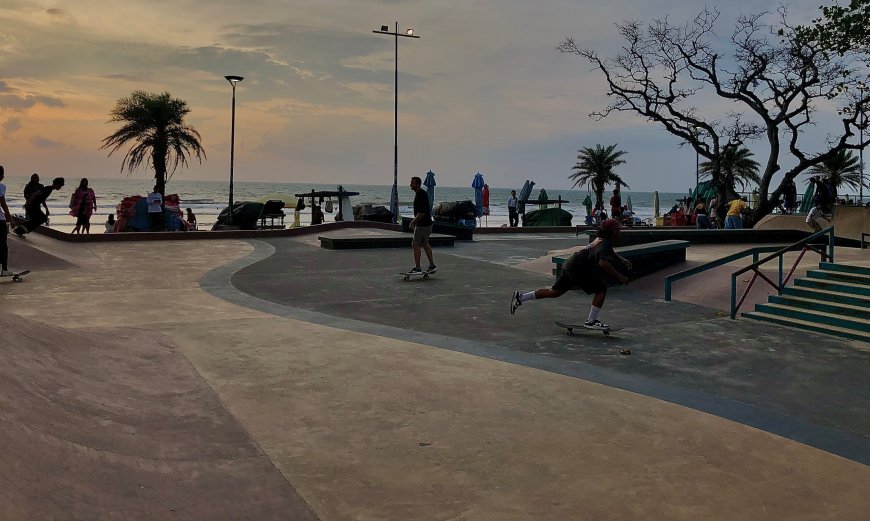
From a side perspective, Kuta Beach Skate Park reveals a spatial layout that stretches parallel to the shoreline. The area is designed as a broad open space, allowing multiple activities to take place simultaneously without disrupting one another. Skate tracks, park benches, and landscape elements are arranged following the contours of the site, forming a spatial composition that feels organized yet flexible for visitors with diverse purposes.
The presence of trees and park lighting along the area enhances comfort, especially in the late afternoon approaching sunset. From this viewpoint, the skate park does not appear as a detached facility, but rather as an integral part of the living coastal environment of Kuta, where sports, recreation, and social interaction coexist within a public space that is open and easily accessible.
Skate Park Visitors (Source: Personal Collection)
A young child and an adult can be seen skateboarding together on the track, creating a warm and friendly atmosphere. This moment reflects how the public space is used across generations, not limited to professional skaters or teenagers, but also serving as a place of learning and exploration for children. Their presence highlights the human dimension of the skate park as a safe and open playground.
More broadly, this scene illustrates the role of the skate park as a space where self-expression can develop from an early age, supported by a natural form of social supervision. Interactions between children, local communities, and other visitors create a sense of togetherness that reinforces the function of urban public space as an inclusive platform within the everyday life of South Bali.
As part of the coastal area of Kuta, Kuta Beach Skate Park demonstrates how urban spaces can evolve into places that are lively, adaptive, and meaningful for the community. Amid the flow of tourism and urban dynamics, this park serves as an example that public space is not only a physical facility, but also a social and cultural environment, a place to meet, to express oneself, and to build a shared sense of belonging.