

























Rupa Tipat: AI Technology Innovation for the Classification and Preservation of Balinese Ketupat
Amidst the relentless tide of modernization eroding traditional values, local cultural heritage is slowly losing its place in the hearts of the younger generation. Among the most vulnerable is the knowledge regarding ceremonial offerings, including ketupat woven coconut leaves filled with rice which are an inseparable part of Hindu rituals in Bali. Recognizing the threat of this ancestral knowledge fading away, an innovative AI-based solution has been introduced: a mobile application called Rupa Tipat.

Ketupat is a fundamental element in both the social fabric and religious rituals of the Hindu community in Bali. Its presence is found in almost every implementation of the Panca Yadnya ceremonies. The various forms of ketupat in Balinese Hindu tradition carry highly diverse and specific functions and symbolic meanings each woven pattern contains deep philosophical weight, ranging from the symbolization of spiritual maturity and self-control over worldly desires to a medium for seeking healing. Unfortunately, knowledge regarding the diversity and meaning of these various ketupat is becoming increasingly difficult to find among the younger generation. Many are no longer able to distinguish one type of ketupat from another, let alone understand its ritual function within the context of traditional ceremonies.
Splash Screen Appearance of Rupa Tipat
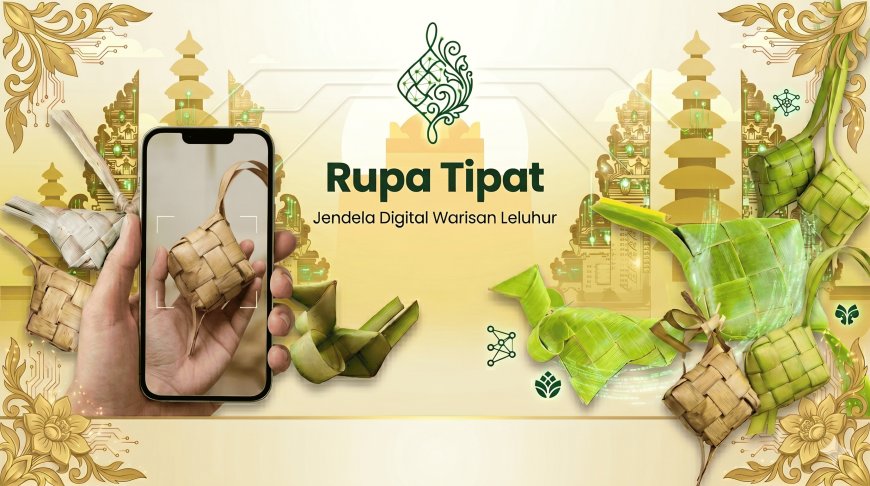
Rupa Tipat is an Android-based mobile application that merges AI-driven image classification technology with a Balinese cultural education platform. The name "Rupa Tipat" is inspired by the Balinese language: rupa meaning "form" or "shape," and tipat meaning "ketupat"—reflecting the app’s essence as a tool to recognize and understand the various forms of Balinese ketupat. The application carries the slogan "A Digital Window to Ancestral Heritage," a statement reflecting its grand vision: to provide the modern public with broad access to identify, understand, and cherish ancestral cultural heritage right from their smartphones.
The application is capable of identifying 13 types of Balinese ketupat with a high level of accuracy. Once the AI model processes the input image, the identification results are displayed in full, accompanied by in-depth information regarding the spiritual meaning, traditional functions, and history of the recognized ketupat. The inclusion of this detailed information feature underscores that Rupa Tipat is not merely oriented toward achieving computational accuracy; it is also determined to serve as a vital digital inventory medium for the preservation of Balinese culture.
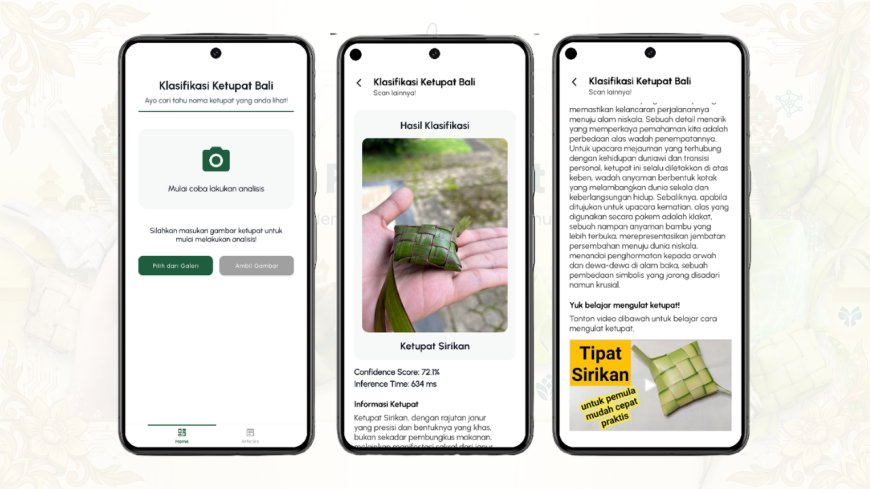
Classification Page View
What makes Rupa Tipat special compared to similar applications is its holistic approach in combining three functions at once: AI-based classification, cultural education, and practical tutorials, all within a single, easily accessible platform. This application utilizes Large Language Model (LLM) technology from Gemini 2.5 Flash to process and present educational information in a more refined, fluid, and easily understandable manner for users from various backgrounds. Furthermore, the integration of YouTube video tutorials allows users to not only learn the names and meanings of the ketupat but also to directly learn how to weave them independently.
Rupa Tipat provides two flexible methods for image capture: uploading a photo from the device's gallery or capturing an image in real-time using a smartphone camera. Once the classification process is complete, the system displays three transparent quantitative data points: the name of the predicted ketupat type, the Confidence Score representing the model's level of certainty, and the Inference Time showing how quickly the model operates.
Rupa Tipat does not simply exist as an image identification tool, but is packaged as a comprehensive cultural learning ecosystem. The following are the main features available within the application:
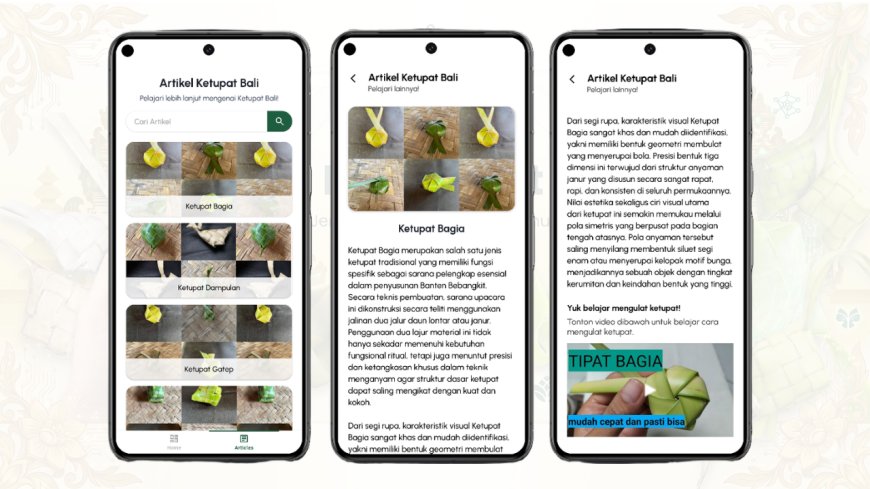
Balinese Ketupat Article Page View
One of the primary scientific values of Rupa Tipat is its ability to classify 13 different types of Balinese ketupat, an achievement that represents a digital inventory effort toward the rich tradition of ketupat weaving in Bali. Each type of ketupat possesses a unique and distinctive weaving form, ritual function, and philosophical meaning, making this diversity a cultural treasure that is highly valuable to preserve. With the AI technology embedded in the application, users can easily identify the type of ketupat before them, whether while shopping at traditional markets, preparing ceremonial offerings, or simply satisfying their curiosity.
The presence of Rupa Tipat is expected to be the answer to the challenges of declining local cultural knowledge in the digital era. This application is not merely a technological innovation, but a concrete movement to ensure that ancestral knowledge regarding ketupat, with all its philosophical meanings and ritual functions, does not simply vanish, swept away by the wave of modernization. This system serves a dual role: as an intelligent tool based on Artificial Intelligence and as a medium for interactive education aimed at revitalizing knowledge of Balinese local wisdom.
Through its user-friendly interface, engaging graphics, and informative content, Rupa Tipat is expected to be accessible and utilized by various groups—ranging from students and practitioners of traditional ceremonies to cultural researchers and tourists who wish to understand the richness of Balinese traditions more deeply. Beyond that, this application is also expected to encourage the younger generation of Bali to feel more proud of and attentive to their ancestral cultural heritage, as getting to know ketupat can now be done as easily as opening a smartphone.
Rupa Tipat is clear proof that technology and tradition do not have to run in opposite directions. When cultural heritage is threatened with fading away, innovations like this become vital—shifting the perspective that preserving culture can now be done in a way that is fun, modern, and easily accessible. Learning about Balinese ketupat no longer requires long conventional study; now, it is as simple as a single camera snap.
Source: “Classification of Balinese Ketupat Types Using the Hybrid Learning CNN Method with Transformer Layer” Made Yurista Indani Sukma, Information Technology Study Program, Faculty of Engineering, Udayana University, Final Project, 2026.