









Tajog in Traditional Balinese Games: Balance, Agility, and Social Values
On two bamboo poles reaching from knee to thigh height, Balinese children once learned something more than simply how to walk: how to keep their bodies steady while continuing to move forward. The game, known as Tajog, is simple in terms of its equipment, yet it carries valuable lessons about perseverance, hard work, and sportsmanship. As children become increasingly immersed in the digital world, Tajog can be brought back as a traditional game that encourages them to step away from their smartphone screens, stay physically active, and enjoy direct interaction with their friends.

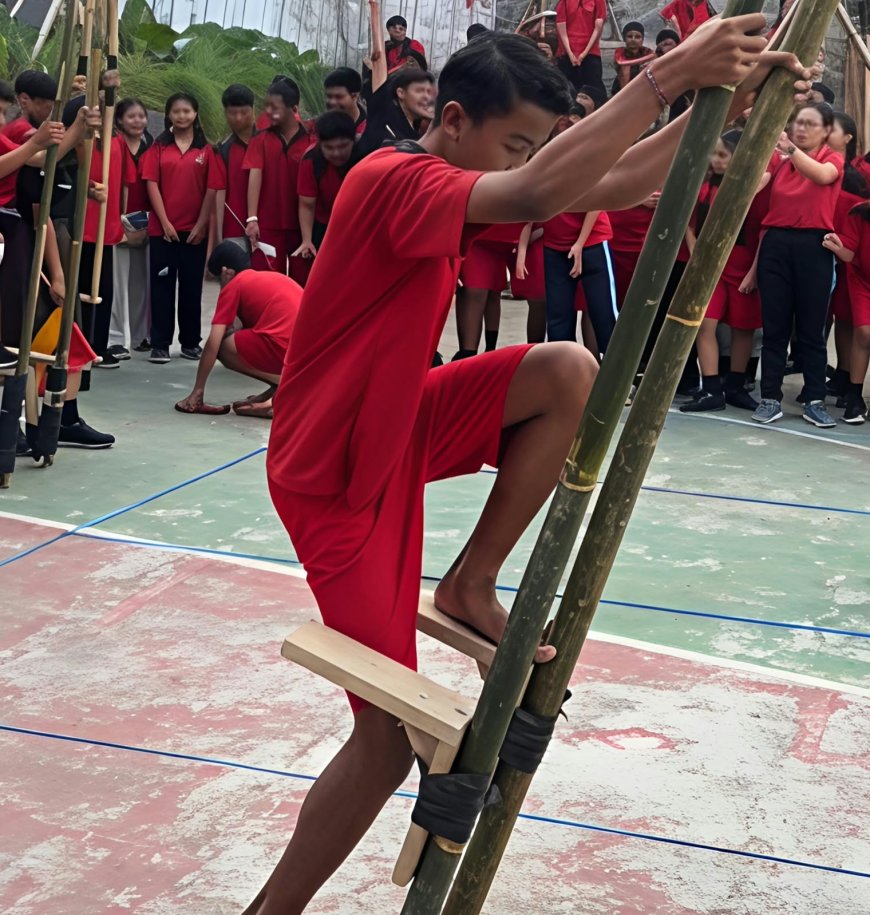
Long before children became familiar with games through smartphone screens, Tajog had already been a part of traditional Balinese games. This game uses a pair of bamboo poles designed as footholds for walking. Its form is simple, but playing it requires balance and agility. In Bali, the game known in various regions of Indonesia as egrang is called Tajog, and to this day it remains one of the traditional games that is reintroduced through various cultural activities.
In the past, playing Tajog did not require complicated equipment. A pair of bamboo poles with footholds was enough to start the game. Players stand on the footholds, then move the bamboo poles alternately to take steps. The game can also be played in the form of a race, so players are not only challenged to remain standing, but also to reach the finish line quickly without losing their balance. From this simple game, Tajog presents a combination of balance, agility, and courage.
Have you ever imagined walking on two bamboo poles without touching the ground? For Tajog players, every step requires the ability to maintain balance while also controlling the direction of movement. A small change in body position can make the footholds unstable and cause the steps to stop. It is precisely this challenge that makes Tajog an interesting traditional Balinese game, both for those who are already accustomed to it and for people who are trying it for the first time.

Tajog and two bamboo poles as the main equipment of the game (Photo Source: Personal Collection)
At first, the biggest challenge may simply be figuring out how to stay standing. Once players become accustomed to it, the challenge changes into how to arrange their steps so that the body can move in the desired direction. The feet, body, and two bamboo poles must work together. Tajog is not only about the courage to stand on bamboo poles, but also about how players control their bodies and maintain stability while moving.
Balance is an important part of this game, and this ability does not come instantly. Players need to try repeatedly until they find the most comfortable way to position their bodies and steps. Falling or losing balance does not mean that the game is over. Instead, through the process of trying, failing, and trying again, players learn not to give up easily. This is where Tajog presents the values of hard work and perseverance behind a simple playing activity.

Maintaining balance on Tajog footholds (Photo Source: Personal Collection)
This seemingly simple game actually provides a fairly diverse experience. There is a physical challenge when players try to maintain their bodies, a learning process when they have to keep practicing, and also social interaction when the game is played together. Tajog ultimately becomes not only an activity to fill leisure time, but also a space for children to move, try something new, and play together.
Tajog is not only introduced as part of learning, but is also still played in various school activities. One example can be seen at SMP Negeri 2 Kuta Selatan, which featured the Tajog game as part of the celebration of August 17th. Amid the atmosphere of the Independence Day celebration, this game became one of the ways for students to rediscover traditional games through direct playing experiences. The activity also shows that Tajog can still be part of school activities and entertainment for the younger generation.
Tajog can also become part of the learning experience for early childhood. This game was once introduced to children in the Senior Kindergarten group at TK Putra Budaya Denpasar through playing activities and demonstrations. The children not only watched how Tajog was played, but also had the opportunity to become familiar with the traditional game directly. Experiences like this make traditional games feel closer because children learn through activities, rather than merely through stories or pictures.
However, the existence of games such as Tajog faces challenges amid changes in children's playing habits. Traditional games are increasingly rarely found as playing activities have increasingly shifted to digital devices. Smartphones offer various types of games that are easily accessible, so children's playing habits have also changed. As a result, Tajog, which could once be found in everyday playing activities, is now more often present on certain occasions, such as competitions or school activities.
Interestingly, changes in the way children play have not caused Tajog to completely lose its place. This game can still be introduced through various media, one of which is through photography. In a photography study at Undiksha, bamboo Tajog was also documented as part of traditional Balinese games through visual reconstruction. The results showed that there are still children who are interested in playing traditional games even amid the widespread use of mobile phone games.
In this way, Tajog is not only introduced through direct playing experiences, but also through technology and works of art. This shows that preserving traditional games does not always have to be done in the same way as in the past. The game itself can remain preserved, while the media used to introduce it can adapt to the development of the times.
The preservation of Tajog can also still be seen in various Balinese cultural activities. In April 2024, the Badung Regency Government organized the Jantra Tradisi Bali Regional Cultural Week, which featured a men's Tajog competition as one of the competition categories. The activity was attended by hundreds of junior high school students throughout Badung Regency and became part of the preparations for the provincial-level event.
A year later, Tajog once again appeared at Pacentokan Jantra Tradisi Bali V, which was part of the series of events of the 47th Bali Arts Festival in 2025. At the provincial level, Men's Tajog was also competed. The Buleleng Regency contingent, represented by students from SMP Negeri 6 Singaraja, managed to win third place. This achievement not only shows the competition involved in the event, but also demonstrates that traditional games such as Tajog are still being learned and practiced by the younger generation.
The presence of Tajog in activities like these shows that the game still has a place within Balinese traditional cultural and sports activities. Tajog is not merely a memory from the past, but remains an activity that is learned, competed in, and introduced to children.

Tajog in competitions and the preservation of Balinese culture (Photo Source: Personal Collection)
The existence of Tajog in education, art, technology, and cultural activities shows that the preservation of traditional games can progress along with the development of the times. The form of the game remains simple, namely walking with the help of two bamboo poles, but the opportunities to introduce it continue to expand. From school grounds, competition arenas, photographic works, to smartphone screens, Tajog has found various ways to remain known.
In the end, Tajog is not only about how quickly someone can walk on bamboo poles. There is a process of finding balance, the courage to try again after falling, and the experience of playing together with others. The challenge for Tajog today is not only keeping the body balanced on bamboo poles, but also ensuring that the game continues to have a place amid changing times. As long as there are still children willing to try it and cultural spaces that continue to give it opportunities to exist, Tajog still has a foothold to keep moving forward.