














I Ketut Gede Antara: From a Single Melody to Thousands of Heirs of Gender Wayang Art
Sanggar Sabda Kencana Sakti (SKS), founded by I Ketut Gede Antara (Pak Tut De) in 2005, emerged from real challenges in the field especially the shortage of gender wayang players during overlapping ritual days. Starting informally by teaching his own child with only two instruments, the studio grew through community support, disciplined technique-based training, and the cultivation of ngayah values. Today, SKS stands as a living legacy that preserves its distinctive “golden” sound and sustains gender wayang across generations.

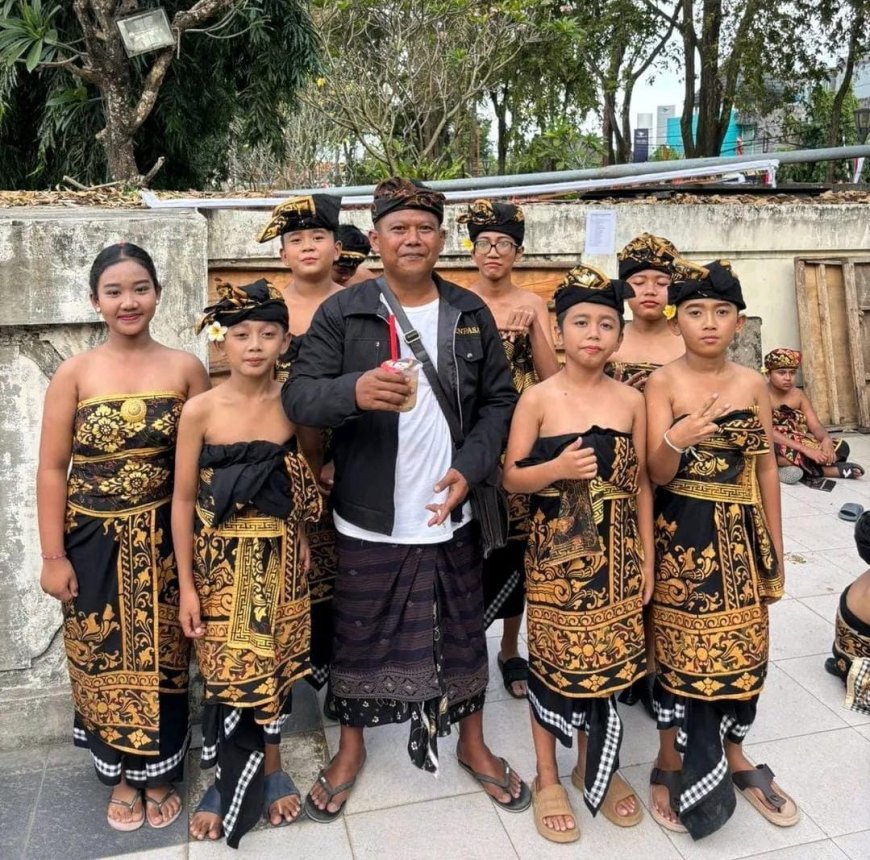
The name I Ketut Gede Antara, widely known as Pak Tut De, is inseparable from the long journey of Sanggar Sabda Kencana Sakti (SKS). He is not merely the founder of the studio, but a living witness to how gender wayang has survived, grown, and been passed down across generations amid various limitations.
The Philosophy Behind the Name Sabda Kencana Sakti
Born from Real Challenges in the Artistic Field
Unlike other gamelan ensembles, finding substitute players is not easy, as gender wayang requires strong technical mastery and prior preparation. This situation often led to scheduling conflicts among performers.
From a Small Collective to an Art Studio
Initially, there was no intention to establish a formal studio. The idea was simply to form a small collective that could ensure the availability of performers for ritual service (ngayah). The first step began at home, by training his own child, who was still in the first grade of elementary school.
With only one piece of repertoire, practice sessions were repeated continuously. The same melody was performed during various ngayah activities in the Ubung Kaja area. Over time, the child’s school friends joined, and the number of learners gradually increased to around twenty people, even though only two gender instruments were available.
Despite these limitations, community support emerged. With minimal government assistance at the time, parents collectively contributed funds to purchase additional instruments. The number of instruments increased from two to four, but the number of students soon rose again to nearly fifty.
Teaching Without Time Limits or Formal Administration
In its early years, the studio operated without formal administration. There were no fixed fees. Contributions from parents were voluntary and often came in the form of daily necessities such as coffee, sugar, or cigarettes.
Training sessions were conducted in shifts. Holidays were fully dedicated to teaching, from morning until late at night. Some children were even left at the studio by their parents from after school until evening. The patience shown by the students while waiting for their turn remains one of the most memorable experiences in the studio’s history.
Gradually, the modest income generated was used to purchase instruments in installments. Today, Sanggar Sabda Kencana Sakti owns dozens of gender instruments, a testament to years of perseverance and consistency.
An Artistic Heritage Passed Down Through Generations
Pak Tut De’s artistic journey is deeply rooted in his family background. Art has flowed through generations, with his father and grandfather known for their strong involvement in the arts, particularly in gamelan music. One influential figure was his uncle, the late Pak Sinti, a respected kerawitan artist who frequently taught and performed abroad.
Learning in earlier times relied heavily on observation and memory, as there were no recordings or digital media. Through interactions with various artists, Pak Tut De became familiar with different styles of gender wayang, including the Kayumas style and other regional variations..
Training Methods and the Transmission of Values
In the learning process, technique is emphasized above all else. Proper mallet grip, striking technique, and damping techniques are taught before introducing repertoire. Based on experience, the most challenging aspect of gender wayang is not memorizing melodies, but mastering correct technique to produce harmonious and refined sound.
The cultivation of love for the arts is achieved through value-based education. Students are introduced to the function of gamelan within the context of Hindu belief. Yadnya is not expressed solely through prayer, but also through sound, music, and artistic devotion. Through this understanding, students learn not only to play, but also to comprehend the deeper meaning behind the art they practice.
Legacy and Hopes for the Future
Personal recognition is not the primary goal. What matters most is generational continuity. As long as young people continue to learn and preserve gender wayang, the mission of the studio is fulfilled.
There is also a strong hope that the government will provide clear platforms and pathways for artists, both in education and professional careers. With proper support, art can develop not merely as a cultural activity, but as a sustainable livelihood.