

































Awaiting the Eggs, Accepting the Unhatched: The Art of Patience and Open-Heartedness in the Story of Dadong Dauh
The "Dadong Dauh" song is a tembang rare (traditional children's song) passed down through generations as both entertainment and a medium for character education. Through the story of a grandmother and her white hen, this song teaches the value of patience in facing social dynamics. Its universal message regarding mental resilience makes this story remain relevant to this day.

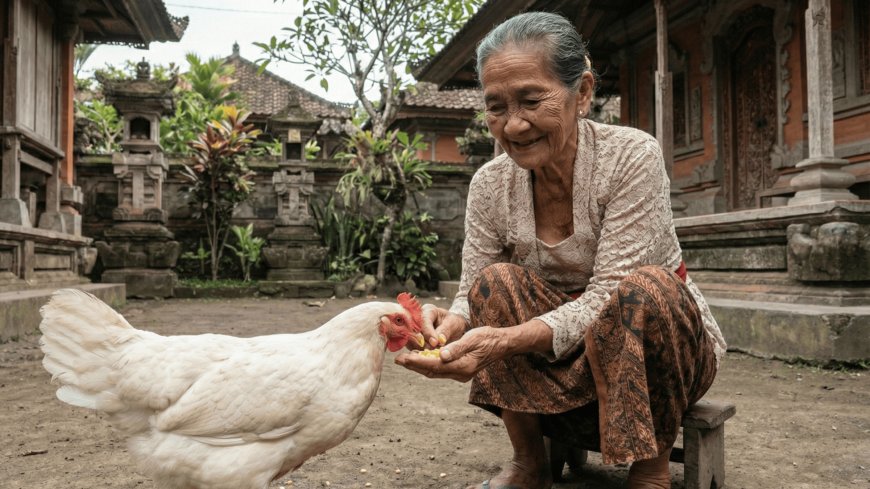
"Dadong Dauh" is one of the legacies of traditional Balinese children's songs that remains preserved today. This song holds a special place because its story very realistically portrays the true face of village society. It tells the tale of Dadong (Grandma) who possesses a valuable asset in the form of a Siap Putih (White Hen). The figure of Dadong represents an elder who works diligently and places great hope in her livestock as an investment for the future.

Mischievous Children Taking the Eggs, AI Illustration (Source: Personal Collection)
The song narrates a human figure living full of hope. She cares for her hen until it lays many eggs (suba metaluh reka), but that hope is dashed due to the actions of mischievous children (anak cerik-cerik gudip) who take her eggs. Whatever the outcome, this song teaches us to accept loss with an open heart. From this story, implied values of tolerance and patience emerge as hallmarks of local Balinese wisdom.
The following are the lyrics to the song "Dadong Dauh":
Dadong Dauh ngelah siap putih (Dadong Dauh has a white hen) Suba metaluh reka (It has already laid many eggs) Minab ada limolas taluhne (Maybe there are fifteen eggs) Nanging lacur ada nak nepukin (But unfortunately, someone saw them) Anak cerik-cerik, anak cerik-cerik (Small children, small children) Kaliwat gudipipun (Their hands are too mischievous)
Cai Ketut metetajen kangin (Cai Ketut goes cockfighting to the east) Papak punang botok (With a smooth-feathered rooster) Tetajene kelangkung ramene (The cockfight is extremely crowded) Cai Ketut magelar a bangsit (Cai Ketut bets 200 coins) Menang duang tali, menang duang tali (Winning two thousand, winning two thousand) Tetajene suba suud (The cockfight is over)

Cai Ketut Winning the Cockfight AI Illustration (Source: Personal Collection)
Furthermore, this song also depicts the contrast of village life. On one hand, Dadong is saddened by the loss of her eggs; on the other, the character Cai Ketut actually wins a bet in the cockfighting arena (tajen). This difference in fate, between the one who loses and the one who gets lucky, reflects the dynamic turning of the wheel of life. This emphasizes that living as neighbors requires a broad heart to accept each other's fates without envy.
The history of this song's birth is rooted in the oral tradition of Balinese society. From generation to generation, it was passed down from parents to children who sang it while playing. Although originating from the past, the narrative of Dadong Dauh remains alive today. Its presence serves as a reminder that traditional values regarding patience never become obsolete, and are even more critical in modern society, which often angers easily when expectations are not met.

Grandma Passing Down Stories to the Younger Generation AI Illustration (Source: Personal Collection)
Thus, the song "Dadong Dauh" is like a gentle reminder that life is a blend of effort and sincerity. It teaches us to keep working hard like Dadong, yet possess a heart as vast as the ocean to accept all possibilities. Preserving this heritage is not merely about singing the lyrics, but nurturing an iron mentality to keep smiling amidst life's uncertainties, respecting others' fortune, and making peace with one's own destiny.