


























Tangkas, Son of Arya Kanuruhan: A Tragedy of Misunderstanding that Nearly Ended a Lineage
This article outlines the historical journey of the Arya Kanuruhan family, a noble lineage originating from the Kediri Kingdom in East Java, which later settled in Bali during the Majapahit era. The main focus is on Prince Tangkas, son of Arya Kanuruhan, who experienced a tragic event caused by a misunderstanding of the king’s decree. This incident nearly brought an end to the Tangkas lineage, but was ultimately resolved through the wisdom of the king, who upheld values of loyalty, dynastic continuity, and socio-political harmony of the time. The history of the Tangkas family is therefore not merely a local narrative, but a reflection of the dynamics of power, loyalty, and the vital significance of heirs in Hindu-Balinese tradition.



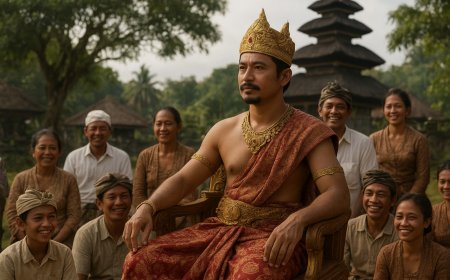
Arya Kanuruhan Leading the Expedition to Bali, AI Illustration (Source: Private Collection)
Arya Kanuruhan descended from the royal line of Kediri. In the 13th century, the Kediri Kingdom was ruled by King Kertajaya, who had a son named Jaya Katwang. From this lineage came Jaya Katha, who, after Kediri’s defeat by Ken Arok, fled to Tumapel with his pregnant wife.
In Tumapel, Jaya Katha’s family was welcomed by his wife’s relatives as well as the family of Kebo Ijo. From this union were born three sons: Arya Wayahan Dalem, Arya Katanggaran, and Arya Nudhata.
The lineage of Arya Kanuruhan stemmed from Arya Katanggaran. From him, through Kebo Anabrang as his father, Arya Kanuruhan was born and later becoming an influential figure in Balinese history.
During Gajah Mada’s expedition to Bali, Arya Kanuruhan joined alongside other Javanese nobles. Majapahit forces initially struggled against Ki Pasung Grigis, yet through Gajah Mada’s diplomacy, Ki Pasung Grigis was brought to Majapahit. As part of the strategy to maintain security in Bali, several Javanese nobles were stationed there, with Arya Kanuruhan entrusted with the Tangkas region.
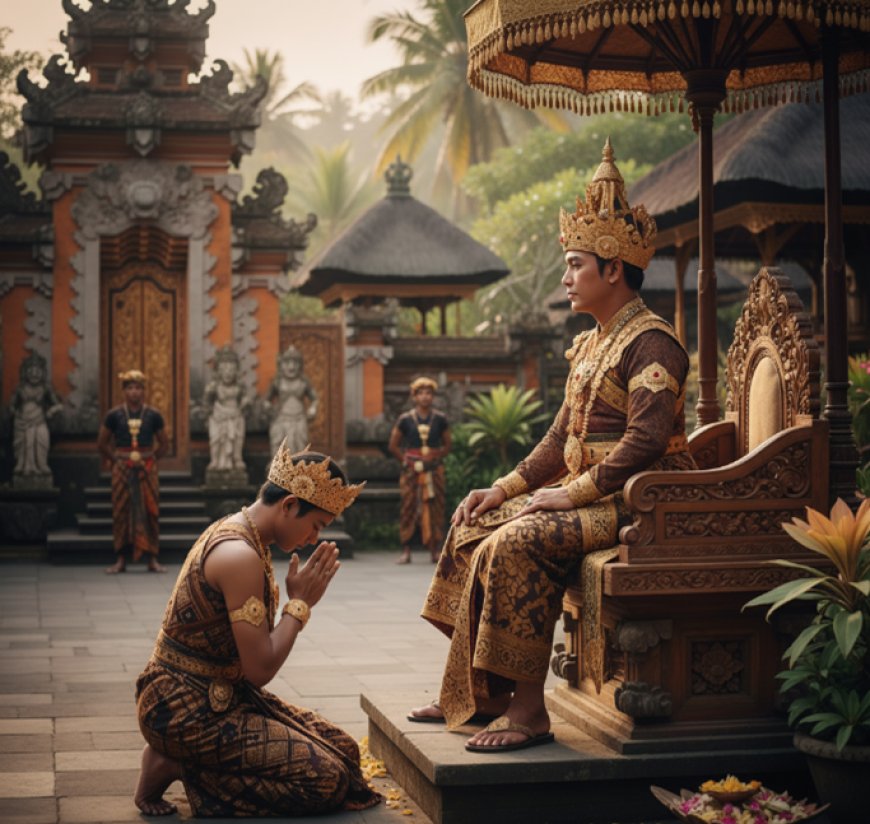
Arya Kanuruhan Loyal to the King, AI Illustration (Source: Private Collection)
Owing to his administrative abilities and esteemed lineage, Arya Kanuruhan was appointed as State Secretary. He had three sons: Arya Brangsinga (the eldest), Arya Kanuruhan (the second), and Arya Pegatepan (the third).

The Three Sons of Arya Kanuruhan, AI Illustration (Source: Private Collection)
Among them, Arya Tangkas or Prince Tangkas emerged as the most prominent. He was entrusted by the king to govern Kertalangu, replacing the descendants of Arya Demung Wangbang who had left the area. Known for his loyalty and integrity, Prince Tangkas was a devoted servant of the king. He had a son, Tangkas Dimade, whom he indulged greatly. Unfortunately, due to excessive pampering, Dimade grew up without learning to read or write—an omission that would later prove disastrous.
One day, the king condemned a man deemed guilty. As punishment, the man was ordered to deliver a letter to Kertalangu. The letter contained a hidden decree: whoever carried it must be executed.
When the man arrived, Prince Tangkas was not at home, and the letter was received instead by Tangkas Dimade, who happened to be in the fields. Unable to read, he handed the letter to his father without realizing its contents.
Upon reading the decree, Prince Tangkas was devastated. According to the king’s command, his own son now appeared to be the condemned bearer of the letter. Torn between paternal love and loyalty to his sovereign, he chose to obey the royal order. Tangkas Dimade, upon hearing his father’s explanation, accepted his fate with resignation.

Prince Tangkas’ Final Advice, AI Illustration (Source: Private Collection)
Amid the weeping of Kertalangu’s people, Tangkas Dimade was led to the cremation grounds. After performing prayers to the four cardinal directions, Prince Tangkas fulfilled the decree by plunging his kris into his son.
Meanwhile, the actual guilty man safely returned to the palace. Shocked by this outcome, the king realized a grave misunderstanding had occurred. He immediately dispatched envoys to prevent the tragedy, but it was too late and Tangkas Dimade was already dead.
The king, filled with regret, recognized Prince Tangkas’ extraordinary loyalty. a father who had sacrificed his only son to fulfill his duty. Yet, from that day, Prince Tangkas refused to return to court despite repeated summons.
To reconcile with him and preserve the Tangkas lineage, the king sent a special envoy. Reluctantly, Prince Tangkas came to Gelgel Palace. The king interrupted an important council to receive him personally, a sign of the deep respect he held for his loyal servant.
The king then made a crucial decision: he arranged for Prince Tangkas to marry Ni Luh Kayu Mas, a pregnant woman from the Bendesa Mas family. The child she bore would become Tangkas Kori Agung.
Biologically, Tangkas Kori Agung was the king’s son. Yet by custom and legitimacy, he was recognized as the heir of the Tangkas family. To strengthen unity between Javanese and Balinese lineages, Tangkas Kori Agung later married into the Arya Kepasekan family.
The history of the Tangkas family shows that loyalty to the king could surpass the instinct of a father. The tragedy that befell Tangkas Dimade illustrates the strength of loyalty in Balinese culture, where devotion to the king could outweigh paternal instincts. At the same time, the king’s wisdom in ensuring the continuation of the lineage through the recognition of Tangkas Kori Agung highlights the importance of ancestral continuity (kawitan) and political stability in shaping Bali’s socio-cultural identity.
References:
- Pengurus Pura Pusat Tangkas Kori Agung Klungkung. Riwayat Arya Kanuruhan dan Pangeran Tangkas Kori Agung. (1987). Klungkung: Pengurus Pura Pusat Tangkas Kori Agung.
- Seregig, I. K. Babad Tangkas Koriagung. (2014). Surabaya: Pramita.
- Supatra, Kanduk. Babad Arya Kanuruhan: Arya Singa Sardhula Bergelar Arya Kanuruhan. (2016). Denpasar: PT. Pustaka Bali Post.