














































Bali–Mataram War 1636: A Battle of Identity and Faith on the Island of the Gods
The Bali–Mataram War of 1636 was a major conflict over identity, religion, and sovereignty. Bali resisted submission to Mataram in order to preserve its Hindu-Buddhist traditions, while Mataram sought to unite territories under Islam. Although Mataram initially captured some coastal areas, Bali’s fierce resistance prevented them from conquering the island. The war left a lasting legacy, strengthening Balinese identity and teaching Mataram the limits of military power.


The Bali–Mataram War of 1636 was not merely an ordinary territorial dispute but a profound war of identity and faith. In the early 17th century, the Sultanate of Mataram under Sultan Agung Hanyakrakusuma was actively expanding its influence in the archipelago. With the ambition of uniting all of Java and its surroundings under the banner of Islam, Mataram regarded Bali—still firmly holding on to Hindu-Buddhist traditions—as an anomaly that had to be subdued. Meanwhile, the Balinese kingdoms, especially centered in Gelgel, saw Mataram as a direct threat to their sovereignty, religion, and way of life. Tensions were worsened by trade issues and claims of control over coastal territories, creating fertile ground for inevitable armed conflict.

Military Defense Strategy, AI Illustration (Source: Private Collection)
Before the war broke out, several diplomatic attempts were made, though they ultimately failed. Sultan Agung sent envoys to Bali with peace offers, but the condition was that the Balinese kings submit to Mataram’s authority. This was flatly rejected by the King of Gelgel, Dalem Seganing, who saw the offer as an insult. The mission was marked by political intrigue and cultural misunderstandings that widened the gulf of differences. Some sources mention Mataram’s attempts to divide the Balinese kingdoms by approaching local rulers separately. However, instead of succeeding, this effort actually united them against a common threat.

Map of the Spread of the Islamic Mataram Kingdom, AI Illustration (Source: Private Collection)
Both sides deployed significant military forces. Mataram, with its organized land and naval armies, employed strategies of siege and maritime assault. Mataram’s troops landed on Bali’s northern coast, attempting to breach the defenses of the local kingdoms. However, they faced fierce resistance from Balinese forces led by skilled commanders. Although the Balinese were inferior in modern weaponry, they had the advantage of geography and employed effective guerrilla warfare strategies. They used mountainous terrain and dense forests to ambush Mataram’s troops. Fierce battles occurred at various points, from the coast to the inland areas.
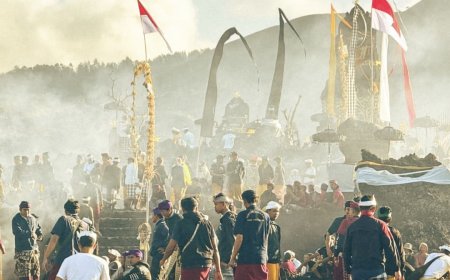
The Balinese resistance was not merely military but also carried religious symbolism. Balinese fighters regarded this war as a dharma yuddha, a holy war to defend their religion and traditions. Numerous rituals and religious ceremonies were conducted to inspire fighting spirit and seek divine protection. This created a highly persistent and uncompromising resistance. Even children and women were involved, providing logistical support or even directly fighting. This heroic Balinese defense reflected their unshakable beliefs, showing that they would not easily surrender to foreign domination.

Statue of an Ancient Balinese Warrior, AI Illustration (Source: Private Collection)
Although Mataram initially managed to capture some coastal territories, they failed to conquer Bali as a whole. The relentless resistance of the Balinese forces, compounded by logistical problems and disease among Mataram’s troops, created great difficulties. Eventually, Sultan Agung decided to withdraw his army. The war ended without an absolute victory for either side. Nevertheless, the impact was immense. For Bali, the war reinforced their identity as guardians of Hindu traditions and strengthened unity among the local kingdoms. For Mataram, this defeat became one of their few military failures at the height of their glory.

Balinese Temple with Distinct Hindu Architecture (Source: Private Collection)
The Bali–Mataram War of 1636 left an important legacy in the history of both regions. For Bali, the war became an epic of resistance passed down through generations, inspiring future generations to safeguard their sovereignty and cultural uniqueness. Tales of the brave Balinese heroes became inseparable from local historical narratives. Meanwhile, for Mataram, this failure was an important lesson about the limits of military power in the face of resistance driven by deep-rooted beliefs. This conflict also illustrated how differences in religion and identity could spark wars, but ultimately could not destroy long-standing cultural foundations.
References
Intisari. (2023, April 18). Kisah Mataram Islam menyerang Bali, kegagalan Sultan Agung mengislamkan Pulau Dewata. Intisari. https://intisari.grid.id/read/033764744/kisah-mataram-islam-menyerang-bali-kegagalan-sultan-agung-mengislamkan-pulau-dewata