












From a Simple Canvas to the World Stage: The Journey of Living Legend Ketut Sadia
Batuan style painting has been officially recognized as an Intangible Cultural Heritage (ICH) of Indonesia since 2018, thanks to its unique perspective-free technique and deeply intricate craftsmanship. Behind the greatness of this traditional art form, Ketut Sadia (60) stands firm as a living legend who has brought the Batuan style to world-class museums. Beyond preserving this heritage on canvas, he also pioneered a free mentoring movement for hundreds of children to keep the flame of tradition alive in his birthplace.

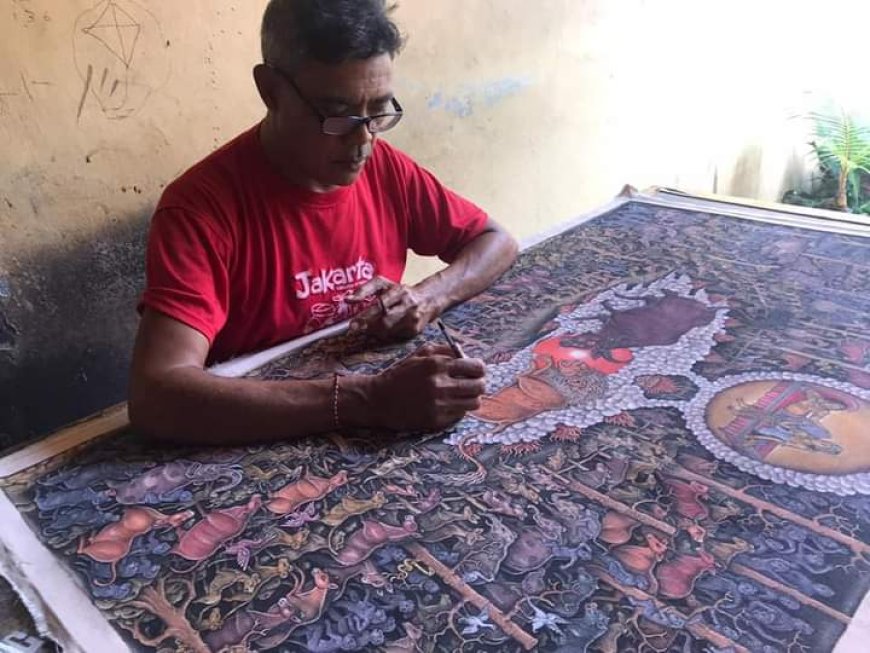
Behind the elegance and beauty of Balinese fine art, which is renowned internationally, Batuan Village, located in Sukawati District, Gianyar Regency, preserves a painting tradition that is deeply distinctive, intricate, and rich in character. Its visual style, dense with narrative detail and imbued with profound philosophy, has long captivated art enthusiasts from around the globe. Recognizing its invaluable cultural and historical significance, the Government of the Republic of Indonesia officially designated Batuan style painting as an Intangible Cultural Heritage (ICH) of Indonesia in 2018. Amidst the waves of modernization and digitalization, Ketut Sadia stands firm as one of the primary pillars sustaining this artistic tradition. Aged 60 years old, Ketut Sadia is no ordinary painter, he is a maestro and living legend whose works have traveled the globe, gracing various international galleries and museums. Beyond creating on canvas, he also carries the moral responsibility of initiating the Baturulangun art community, which educates the next generation free of charge.
The maestro’s long journey in loving the world of fine art did not emerge overnight; rather, it was deeply bound to him since he was in the 3rd grade of elementary school. Growing up in a multi-generational family of artists, young Sadia’s rhythm of life was constantly shaped by the scent of paint, ink, and the stroke of brushes. His artistic lineage runs deep, beginning with his grandfather, Nyoman Ngendon, a legendary painter and respected freedom fighter. This artistic blood was passed down to his father, I Wayan Taweng, as well as his uncle, Ketut Tomblos, who was also known as a talented Batuan painter.
The warm artistic atmosphere in his home grew even richer as his siblings also dedicated their entire lives to the visual arts. His elder brother, Wayan Bendi, is widely recognized as a maestro of the Batuan style, while his younger siblings, Wayan Diana and Made Geriyawan, remain steadfast on the same artistic path. Sadia learned to paint self-taught simply by observing his parents work whenever he returned from school. "I learned to paint self-taught by watching my parents paint. Coming home from school, the first sight I saw was my parents holding brushes," Ketut Sadia recalled. From those simple moments on the terrace of his home, the seeds of a deep love for Batuan style painting began to take firm root in his soul.
The complexity and beauty of Batuan style painting have always invited admiration from art observers. The term "Batuan style" itself was actually a moniker first bestowed by international art collectors and observers around the 1970s. According to Ketut Sadia, mastering this painting style thoroughly cannot be achieved in just 5 to 10 years due to its extraordinary level of difficulty and technical depth.
The primary characteristic distinguishing the Batuan style from other painting styles lies in the simultaneous use of two brushes during the painting process. In this technique, the artist holds two brushes with different functions: one brush is used to apply color or ink, while the second brush, dampened with water, serves to smooth out color gradations and create subtle lighting nuances, locally known as ngucek or nyawi.
In addition to the distinctive two-brush technique, Batuan style painting steadfastly adheres to a visual principle called memedeg. The memedeg principle is a step-by-step, systematic painting process worked from the bottom toward the top of the canvas. Its main characteristic is filling the entire surface of the canvas without leaving any empty space. In a Batuan style composition, no single object is highlighted dominantly or exclusively; rather, every corner of space is filled with dense narrative details and storytelling elements. Another uniqueness favored by Ketut Sadia is the absence of specific rules of perspective. "What I like most about the Batuan style is the absence of specific rules of perspective. Without perspective, artists actually gain the maximum freedom to create," Sadia explained.
Ketut Sadia's international achievements began at a very young age, specifically while he was still a high school student in 1985. At that time, young Sadia's painting was selected for a prestigious traditional painting exhibition and competition in Fukuoka, Japan. This participation was a valuable milestone, as his creation stood alongside world-class museum paintings. The achievement became even more remarkable when his artwork was not only stored and permanently displayed at the Fukuoka Museum, but was also selected as the cover image for an exhibition book titled Bali Batuan, printed in Japanese Kanji script. This historic event in Fukuoka served as a crucial turning point and the greatest source of motivation for young Sadia to firmly walk his path as a Batuan style painter.
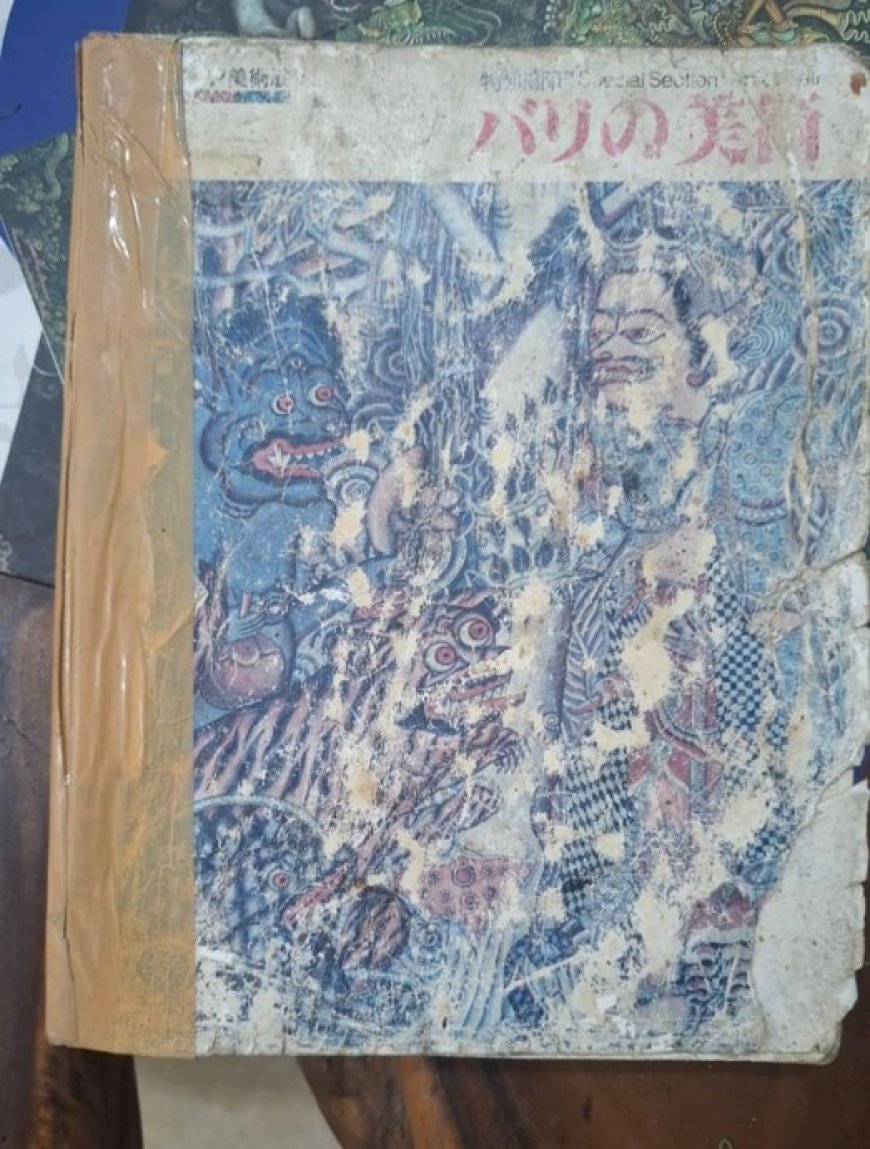
The Painting by Ketut Sadia Selected for Fukuoka, Japan, which Became the Cover of the Fukuoka Museum Book (Source: Personal Collection)
Sadia's legacy of achievement and global recognition for his expertise continued throughout his artistic career. In 2015, his painting again received a great honor when it was chosen as the cover of an art exhibition book in Finland. Extending beyond Europe and East Asia, his works have also been periodically featured in prestigious museum exhibitions from Singapore to the United States. Sadia's brilliance is recognized not only internationally, but also nationally. One of his masterpieces, titled Sidang Wakil Rakyat Negeri Antah Berantah (Session of Representatives from Neverland), successfully passed intense competition to earn a spot as a finalist in The 2nd UOBI Painting of the Year Competition 2012 held in Jakarta.
As a free-spirited artist, Ketut Sadia has always dared to break away from rigid traditional themes without discarding or compromising the pure techniques inherited from Batuan ancestors. While steadfastly preserving traditional techniques, he remains very open to incorporating contemporary issues and wild imagination into his canvases. For Sadia, the ultimate satisfaction for a painter comes when creating an authentic work born from their own original thought without merely responding to or recreating the work of others.
The creative philosophy he holds dear is "making what does not exist come into being." This imaginative philosophy is sharply expressed in his masterpiece titled Pentas di Bulan (Performance on the Moon). In this painting, Sadia merges traditional Balinese mythology such as the tale of Dewi Ratih (the Moon Goddess) and Kalarau (the moon-devouring giant) with futuristic objects like UFO flying saucers, while depicting the vibrant spectacle of locals and artists enthusiastically performing gamelan, Barong, and dragons in outer space.
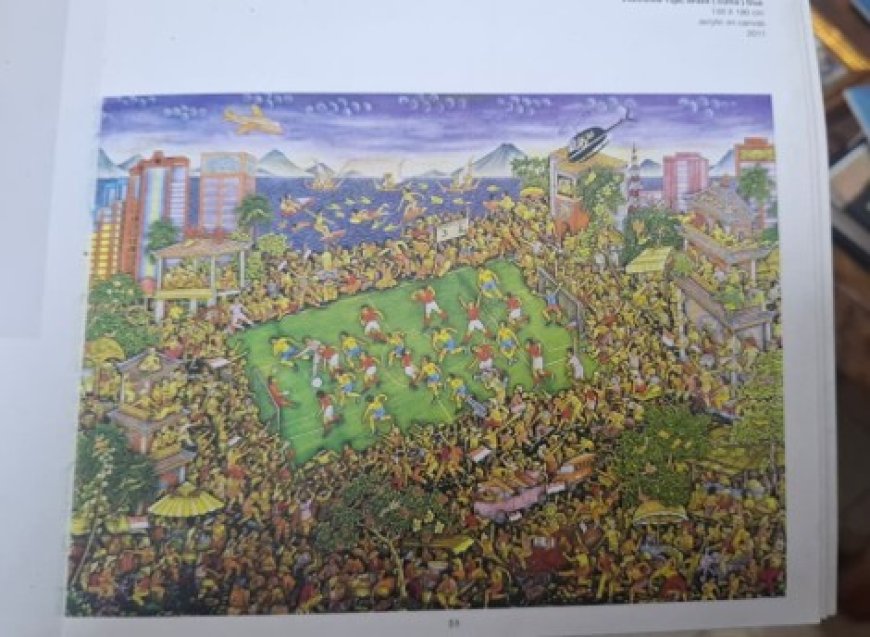
The World Cup Painting by Ketut Sadia Entered into the 2012 Jakarta Awards (Source: Personal Collection)
Beyond weaving fantastical imaginations, Ketut Sadia often uses his canvas as a medium for subtle yet piercing social critique. This is clearly seen in his work nominated for the 2012 Jakarta Award, titled Piala Dunia (World Cup). In this narrative painting, Sadia depicts an imaginary football match between the Indonesian national team and the Brazilian national team, complete with a scoreboard displaying a 3-2 victory for Indonesia. Upon seeing the World Cup painting, former Minister of Tourism and Creative Economy Mari Elka Pangestu asked in wonder how Sadia thought of such a unique theme. Sadia merely laughed and replied that such is the true dream of an artist: to manifest hopes that do not yet exist in the real world onto canvas. In addition to addressing sports, Sadia also adaptively captures contemporary moments like the construction of the Nusantara Capital City (IKN), while remaining faithful to producing paintings imbued with sacred traditions, such as Atma Kerthi and Sang Hyang Jaran.
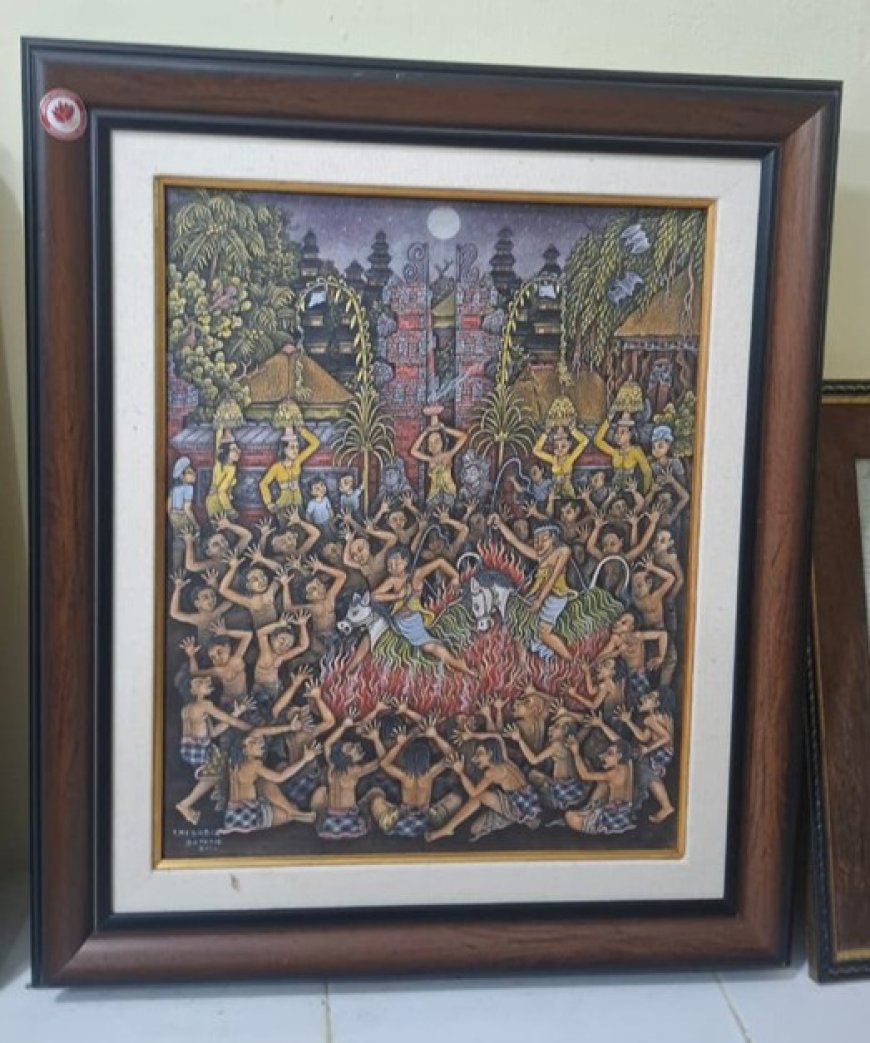
The Sang Hyang Jaran Painting by Ketut Sadia (Source: Personal Collection)
A maestro's long and glorious journey has not made Ketut Sadia forget the future of his cultural heritage. He felt concerned witnessing the younger generation's interest becoming distracted by modern technological developments and various gadget entertainments. Recognizing the threat of breaking the chain of tradition, Ketut Sadia, together with local Batuan artists, took concrete steps by initiating the founding of the Baturulangun Batuan Painters Association in 2012.
Since 2015, through the Baturulangun platform, Sadia and his fellow artists began conducting free art mentoring programs without charging any fee for elementary school children, specifically starting from 3rd-grade students. From this fee-free program, hundreds of young Batuan style painters have emerged. Their students' works are frequently included in professional exhibitions. Whenever a student's work garners interest and is purchased by collectors, the sales proceeds are reallocated and channeled back as donations to support training operations and the development of art for the next generation.
For Ketut Sadia, painting in the Batuan style is not merely an activity of applying colors onto canvas, but a process of spiritual education to instill a core life value, patience. This patience does not arise without reason. Batuan style painting demands extremely high patience, especially with its complex two-brush technique, requiring the artist to be extra cautious when applying lines and colors. This deep creative process often causes artists to lose track of time to the point of forgetting to eat when bound by the flow of inspiration.
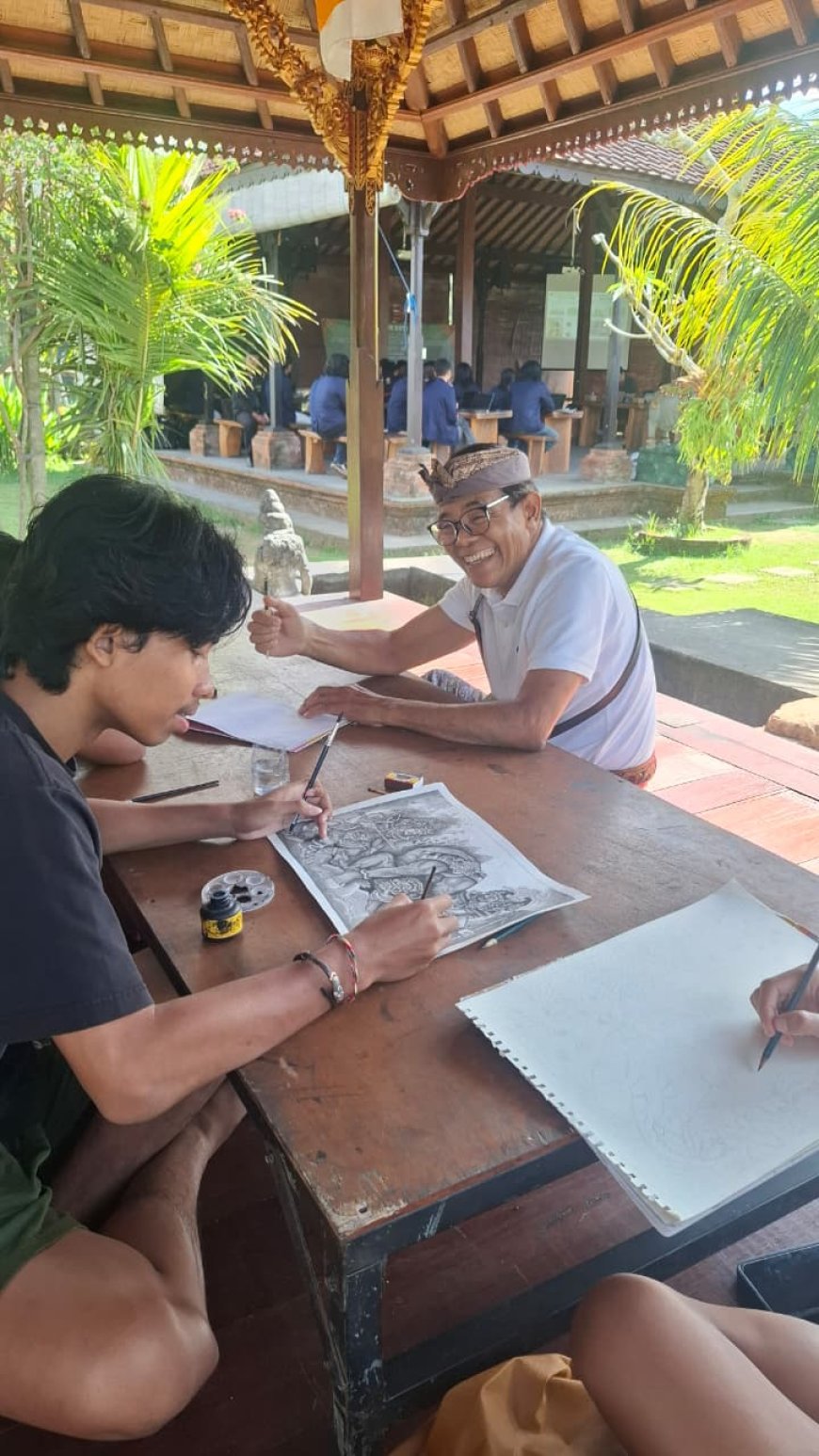
Ketut Sadia Teaching Children to Paint at Baturulangun (Source: Personal Collection)
However, it is important to remember that beyond commercial functions or economic value alone, painting for the Balinese community is also meaningful as a form of ayah-ayahan a manifestation of sincere devotion and spiritual offering for the community and temples through the creation of religious items such as kober (sacred banners) and umbul-umbul (pennants). Through his unwavering life dedication and the platform of the Baturulangun Painters Association, Ketut Sadia continuously imparts a profound message to children and the younger generation not to be monotonous or overly rigid in drawing. "My message for children and the young generation, don't be monotonous, don't be too rigid in drawing. Free your creativity, but as for technique, hold firm to the Batuan painting style," concluded the legend.