










































I Dewa Karangamla and Janda Batan Jeruk: Political Intrigue and the Dynamics of the Balinese Court in the 16th–17th Century
Balinese history in the 16th and 17th centuries was marked by numerous political intrigues, power struggles, and struggles among court nobles. One fascinating story involves the incident involving I Dewa Karangamla and Janda Batan Jeruk, which illustrates how the dynamics of court politics were determined not only by military power but also by marriage strategies, intrigue, and socio-cultural legitimacy. This intrigue cannot be separated from the broader context of Bali at that time, which was in a transitional period between Gelgel hegemony and the rise of local dynasties.


In the 16th century, the center of Balinese power was under the Kingdom of Gelgel. The Gelgel kings tried to expand their political influence throughout Bali to Lombok and Sumbawa. However, the domestic political situation has never been truly stable. Conflicts between the nobility, local rebellions, and succession conflicts were frequent. In this situation, an interesting story emerges about I Dewa Karangamla and Janda Batan Jeruk, two figures whose meeting became an important point in the formation of the political history of eastern Bali.

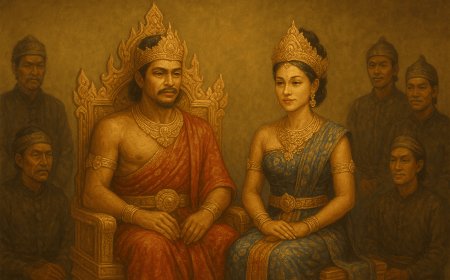
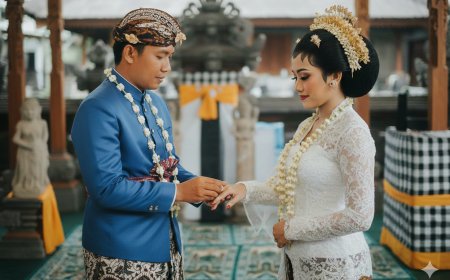
Illustration AI of the Meeting of I Dewa Karangamla and Janda Batan Jeruk (Source: Personal Collection)
I Dewa Karangamla was known as an ambitious and calculating nobleman. He comes from an influential family and has big aspirations to cement his position in Bali's complex political vortex. Meanwhile, Janda Batan Jeruk is a noble female figure who has lost her husband, Arya Batan Jeruk, an important figure in the local dynasty. Despite her widowhood, her position remained strong as she carried her family's great name and had a son who became the rightful successor to the Aryan lineage. In Balinese political tradition, noble women are not only seen as complementary, but often key to determining the direction of power. The Janda Batan Jeruk is a tangible proof of that.
The meeting between I Dewa Karangamla and Janda Batan Jeruk took place in a turbulent political context. Gelgel, though powerful, began to show signs of weakening, while the local nobles looked for ways to expand their influence. Karangamla saw a great opportunity in establishing an alliance with the Janda Batan Jeruk, because with the marriage she not only obtained a partner, but also the legitimacy of the Arya Batan Jeruk lineage. The intrigue involving I Dewa Karangamla and Janda Batan Jeruk began with internal competition between the noble family. Karangamla sought to strengthen his position in the palace through a network of political marriages. Marriage in the Balinese nobility at that time was not only a personal affair, but also a political instrument to expand the influence and legitimacy of power.

Illustration AI of the Gel-gel Kingdom in the 17th century (Source: Personal Collection)
Karangamla's marriage to Batan Jeruk Widow took place as a political alliance with multiple meanings, beyond just a personal bond between two individuals. This story shows that in Balinese politics in the 16th–17th centuries, noble women not only played a passive role as objects of political exchange, but could also appear as important actors in the dynamics of power, even as determinants of the direction of royal policy.The widow of Batan Jeruk, with her high social status and the network of influence she had from her previous marriage, brought with her significant political capital ranging from access to economic resources, the loyalty of her late husband's followers, to the spiritual legitimacy inherent in her extended family. This marriage thus not only unites two individuals, but unites the two political power centers that previously stood apart.
In Balinese culture, royal marriages are often a more powerful instrument of diplomacy than war, as they unite honor, blood, and legitimacy in a sacred and unbreakable bond. In contrast to military conquests that can lead to resentment and sustained resistance, marriage creates an emotional, spiritual, and genealogical attachment that binds both parties in a relationship of mutual dependence. Through marriage, potential enemies can be turned into allies, and rivalries can be defused through customarily binding kinship lines. This strategy allowed for the expansion of influence without having to incur large war costs, both in the form of casualties and material losses.
This bond is not only a symbol of the unification of two large families, but also shows how the marriage strategy can fundamentally change the political balance in the palace. By marrying Janda Batan Jeruk, Karangamla strategically expanded his support base, strengthened his position amid the palace's internal rivalries, and built bridges to factions that might have previously been neutral or even opposite. This marriage also opened up access to land, followers, and economic resources that were previously beyond its reach. More than that, the descendants born of this marriage would inherit the dual legitimacy of the Karangamla line and from the Batan Jeruk family line creating a more solid dynasty foundation that would be difficult for political rivals to shake. In this context, marriage serves as a long-term investment whose impact will continue to be felt beyond the generations that governed it, shaping the political landscape of Bali for decades to come.

Illustration AI I of Dewa Karangamla shaking hands with representatives of the family of Janda Batan Jeruk (Source: Personal Collection)
The benefits of this marriage are wide-ranging, not only limited to the family sphere, but also resonating with the political realm of East Bali as a whole. First, Karangamla gained political legitimacy which further strengthened his position among the nobility. Without this legitimacy, his position may continue to be questioned, even seen as fragile by his opponents and political allies. With the legitimacy born from this marriage, Karangamla was able to build a stronger authority and was trusted as the legitimate ruler. Second, a strong social and cultural alliance is created, because marriage is not just the union of two individuals, but the union of two groups of nobles who previously had their own interests. This bond became a new foundation that was difficult to shake by internal conflicts and external interventions. Third, from this marriage was born the foundation of a new dynasty which would later be known as Karangasem.
The presence of the son of Janda Batan Jeruk who was appointed as the heir not only strengthened Karandamala's claim to power, but also paved the way for the birth of a new center of power that had a great influence in the eastern Bali region, even extending to Lombok in the following times. Last but not least, this marriage also affirms the strategic role of women in politics. Through the figure of Janda Batan Jeruk, it can be seen that noble women are not only complements in the dynamics of the kingdom, but also important actors who can determine the direction of legitimacy, stability, and sustainability of the dynasty.

Illustration AI of the Birth of the Kingdoms of Klungkung, Karangasem, Buleleng, and Badung in Bali (Source: Personal Collection)
The intrigue between I Dewa Karangamla and Janda Batan Jeruk has wide implications. First, he shows the fragility of Gelgel's political stability, which finally weakened at the end of the 17th century. Second, this rivalry is a reflection of the pattern of power in Bali, where legitimacy is not solely determined by lineage, but also by the ability to play political strategies and social alliances. Conflicts like these ultimately contributed to the political fragmentation of Bali, which later gave birth to new kingdoms such as Klungkung, Karangasem, Buleleng, and Badung.
The story of I Dewa Karangamla and Janda Batan Jeruk is a vivid picture of how political intrigue, marriage alliances, and the struggle for legitimacy shaped the dynamics of the Balinese court in the 16th to 17th centuries. This intrigue not only shows the severity of the power struggle among the Balinese aristocracy, but also shows the strategic role of noble women in determining political direction. From this story, we can see that the history of Bali is not only decorated with wars, but also full of strategies, intrigues, and complex social dynamics.
Bibliography:
Alit, D. M., Yasa, I. N. K., Mahadewi, N. P. R., Arsana, I. K. Y. A., & Putra, N. Y. N. (2021). Peran Rohaniawan dalam Mewujudkan Keagungan Kerajaan Gelgel. Social Studies: Jurnal Pendidikan Dan Ilmu-Ilmu Sosial, 9(1), 101–110. https://ojs.mahadewa.ac.id/index.php/socialstudies/article/view/2890
Purnawati, D. M. O. (2012). Polarisasi Geo Politik Kerajaan di Bali Abad XVI-XX. Media Komunikasi FIS, 11(1), 1–15.
Kabupaten Karangasem. (n.d.). Sejarah. dari http://v2.karangasemkab.go.id/index.php/profil/17/Sejarah