






































Malam Minggu, Langite Galang: A Romantic Expression Behind Balinese Peparikan
Behind its simple verses, peparikan Bali holds life advice that is subtle yet profound. From expressions of sincere love, to satire for those who talk too much, and even an invitation to preserve cultural heritage, all are present within four meaningful lines. Through peparikan, the noble values of the ancestors continue to live and remain relevant amidst the currents of time.

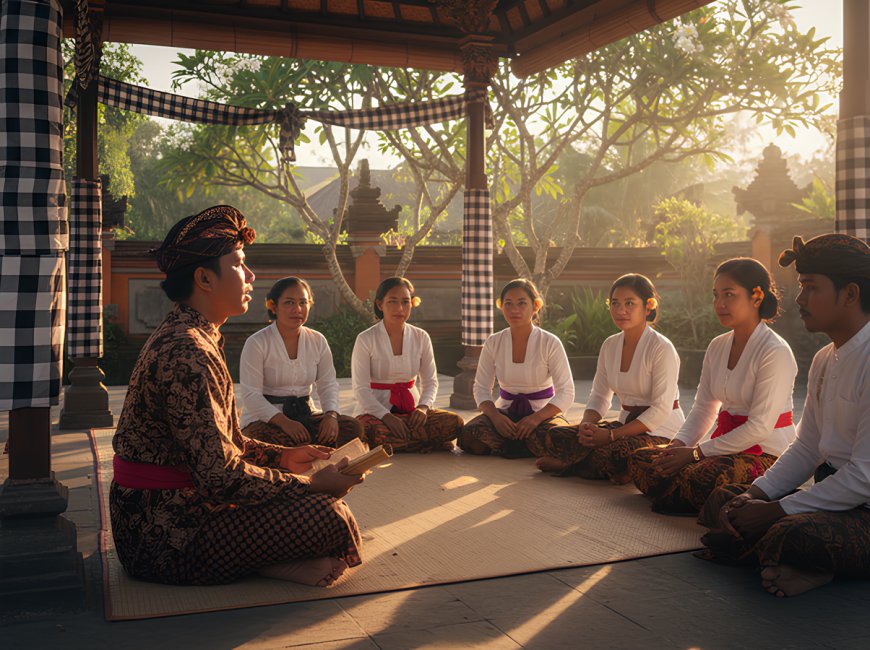
In the colorful ocean of Balinese literature, peparikan appears like a small gem that is simple in form, yet radiates a brilliance of meaning that does not fade with time. It is a traditional Balinese pantun, in the form of a four-line stanza that flows gently to the ear, guiding feelings, and touching the heart. The first two lines, called sampiran, are like paintings of nature or portraits of daily life. The following two lines, which form the isi, hold messages, satire, or advice.
Peparikan is not only a play of sound, but an art of language that flows from ancestral wisdom. Its rules are like the steady rhythm of gamelan: four lines in one stanza, alternating rhymes that maintain harmony, and language that may take different forms, sometimes refined, sometimes moderate, and sometimes straightforward. Altogether, peparikan is easy to remember, pleasing to hear, and full of values.
The greatness of peparikan lies in its ability to convey messages beautifully. It admonishes without preaching, advises without forcing, and entertains while guiding. There are peparikan that mock people who talk too much, some that remind about loyalty, and some that tell of love. All come together in a brief form, like a drop of dew reflecting the vastness of the sky.

Couple Under the Moon, AI Illustration (Source: Personal Collection)
“Malam minggu, langite galang,”
Meaning: Saturday night, the sky is bright
“Ambune selem melayang-layang.”
Meaning: Black clouds are floating around
“Sampunang ragu ngenyakin tiang,”
Meaning: Do not doubt believing in me
“Tresnan tiange sekayang-kayang.”
Meaning: My love is forever
This peparikan portrays the diversity of feelings in love. The bright night sky symbolizes hope and sincerity, while the black clouds symbolize doubts that can block conviction. A deep message of love appears: an invitation not to hesitate, because the affection is real. In the end, “tresnan tiange sekayang-kayang” affirms a sincere love and a faithful promise to be kept forever.
“Meli gabus duang kranjang.”
“Lamben bodag sing ngenyakin.”
“Yadin bagus mata keranjang.”
“Enyen kodag mangenyakin.”
Apart from expressions of love that are full of hope, there are also expressions like the ones above which emphasize the importance of loyalty in relationships. Even if a man is handsome and charming, if his heart easily strays, then no woman can truly trust him. The message is clear: appearance is not the main measure, but sincerity and loyalty are the foundation of a true relationship.

Woman and Black Dog, AI Illustration (Source: Personal Collection)
“Negul kuluk di adeg-adeg”
Meaning: Tying a dog to the house pillar
“Kuluk badeng cara celepuk”
Meaning: A black dog like an owl
“Dadi nak luh harus dueg”
Meaning: A woman must be smart
“Apang sing bakat uluk-uluk”
Meaning: So as not to be easily deceived
This peparikan delivers wise advice with simple symbols. The black dog represents vigilance and firmness. The advice is that women must always be intelligent and cautious. The last line emphasizes that wisdom protects from being deceived. The meaning is not only for women but also a universal reminder that intelligence and vigilance are keys to self-protection.
“Ngalap wani ngaba kemong.”
“Dara lanang suba mati.”
“Anak jani liunan omong.”
“Mara sekenang tan pabukti”
In line with this message of vigilance, there is also another peparikan with a tone of social satire. This peparikan delivers a subtle yet firm critique toward those who boast or make loud claims without any real proof. The third and fourth lines illustrate that people who talk excessively or act arrogantly often, when put to the test, fail to prove anything at all. The meaning contained within is an invitation not to become someone who is merely skilled at speaking, but to also demonstrate real actions as a reflection of responsibility and integrity.

Man Cursed, AI Illustration (Source: Personal Collection)
“Doyan liang ngandong kanji”
Meaning: Really likes carrying kanji
“Depang tiang ngaba pintu”
Meaning: Let me bring the door
“Yan tiang ngelong janji”
Meaning: If I break my promise
“Apang tiang kena kutuk”
Meaning: Let me be cursed
This peparikan carries a message about sincerity in keeping promises. The first and second lines serve as the sampiran, while the third and fourth lines deliver the true meaning. Here, the speaker emphasizes that a promise is sacred. If it is broken, they are willing to accept a curse as a consequence. The deeper meaning of this peparikan is the emphasis on responsibility, honesty, and integrity in relationships, whether in friendship, romance, or social life in general. It teaches that a promise is not merely words, but a commitment that must be upheld with sincerity.

Balinese Traditional Ceremony, AI Illustration (Source: Personal Collection)
“Numbas wani ka kota Bangli”
Meaning: Buy wani fruit in Bangli city
“Lakar aba mulih ke Kutri”
Meaning: Will be brought home to Kutri
“Ngiring ajengang seni budaya Bali”
Meaning: Let us preserve Balinese art and culture
“Apang setata ajeg lestari.”
Meaning: So that it will always endure and remain everlasting
This peparikan is a moral call to preserve Balinese cultural heritage. The sampiran mentions buying wani fruit, while the isi emphasizes preserving Balinese art and culture. Its meaning is a collective message for society, especially the young generation, to safeguard and develop culture as the identity of Bali. Thus, ancestral values will continue to live and remain steadfast through time.

Beautiful Woman and Starling Bird, AI Illustration (Source: Personal Collection)
“Be curik mabasa manis”
Meaning: The starling bird chirps sweetly
“Bungkung pendok sedeng di tujuh”
Meaning: A ring like a turtle’s shell fits the index finger
“Bajang cerik kanyungne manis”
Meaning: A little girl with a sweet smile
“Selat tembok makita nyujuh”
Meaning: Blocked by a wall yet still wants to reach
This peparikan illustrates the beauty and sincerity of affection. The first two lines function as the sampiran, presenting the atmosphere of nature through the melodious sound of a jalak bird and simple objects around. Meanwhile, the essence of the verse is implied in the third and fourth lines, which tell about a little girl with a sweet smile radiating charm, even though there is an obstacle such as a wall separating them. Its meaning is that sincerity of heart and the beauty of a smile can surpass boundaries and barriers, allowing affection or attraction to be felt despite distance or obstacles.
Peparikan Bali is a treasure of words, a heritage from the ancestors that is not only beautiful in sound but also noble in meaning. It is a mirror of the Balinese soul, always seeking harmony between words and actions, between appearance and heart, between feeling and logic. Amidst the swift currents of modern times, peparikan stands as a reminder that wisdom does not always reside in thick books, but can dwell in four simple lines born from the people’s tongue. By preserving peparikan, we are safeguarding the heartbeat of Balinese culture, while also nurturing the language of love and wisdom passed down from generation to generation.